
“The best roundabout designs are shaped by principles, not templates.”
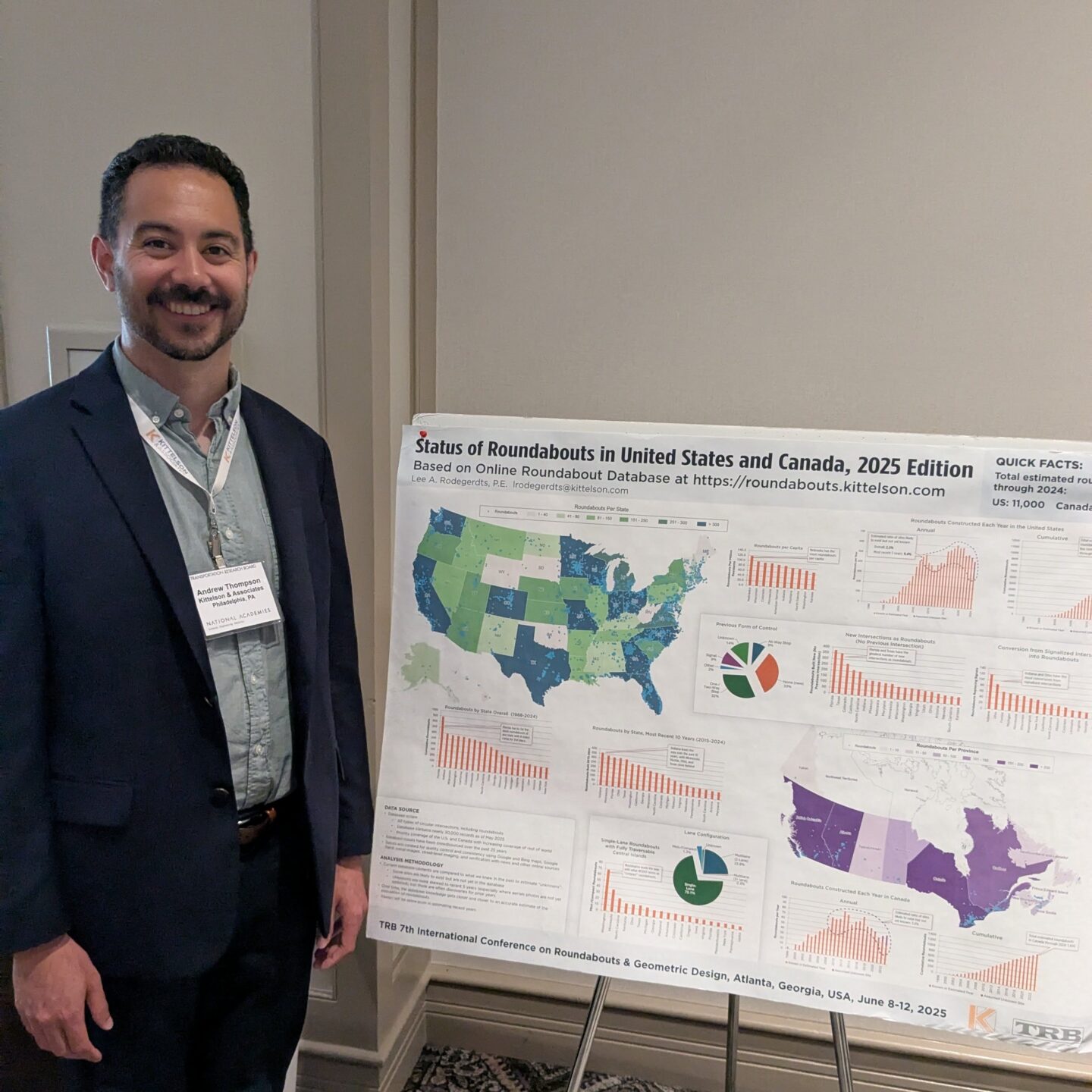
We’re an interconnected nationwide team, but we each have our own reasons for being passionate about the work we do. This month, get to know Andrew Thompson, a Senior Engineer in our Philadelphia office.
What’s your background and how did you end up at Kittelson?
I grew up in Southern California and moved to Philadelphia to attend Drexel University. Through Drexel’s co-op program, I began working at a local engineering firm that designed and reviewed roundabouts throughout the region. After eight years there, I was ready for a new challenge.
Much of the research and design guidance I relied on in that role had Kittelson’s name on it, so I was excited to learn the firm had an office in Philadelphia. It has been a great opportunity to continue my work in Pennsylvania while expanding my experience nationally and learning from some of the industry’s leading roundabout experts.
What do you enjoy outside of work?
Philadelphia is such a walkable city, and I love discovering new places by foot or bike. I’m also on an ongoing quest to find the best bagel sandwich in town. Outside of work, you’ll usually find me practicing yoga, hiking, reading, or spending time with friends.
Do you remember the first roundabout project you worked on? What stood out to you?
I think the first roundabout I designed was the Portzer Road Roundabout in Bucks County, Pennsylvania. The site was environmentally constrained, requiring the design to avoid streams and wetlands while still meeting operational needs.
What fascinated me most was the flexibility of the design process. The roundabout’s geometry was developed around performance goals, including truck movements and fastest-path checks, rather than a one-size-fits-all standard. That project helped shape my perspective on principle-based design, which continues to influence how I approach intersection projects today.
What’s the biggest misconception people have about roundabouts?
In the Philadelphia region, a common misconception is that roundabouts and traffic circles are the same. We frequently hear questions like, “Aren’t they taking these out in New Jersey?” or concerns about whether trucks can navigate them safely.
That’s why public involvement is such an important part of the design process. It helps dispel misconceptions, answer questions, and build confidence that the roundabout will work for everyone who uses it.
Is there a roundabout project you’re particularly proud of, and why?
I’ve always enjoyed peer review work, especially when it involves helping a designer through their first roundabout project. As one of my mentors, Ed Myers, likes to say, “We can’t design every roundabout.” There’s a real sense of satisfaction in sharing knowledge and watching someone else’s project come together successfully.
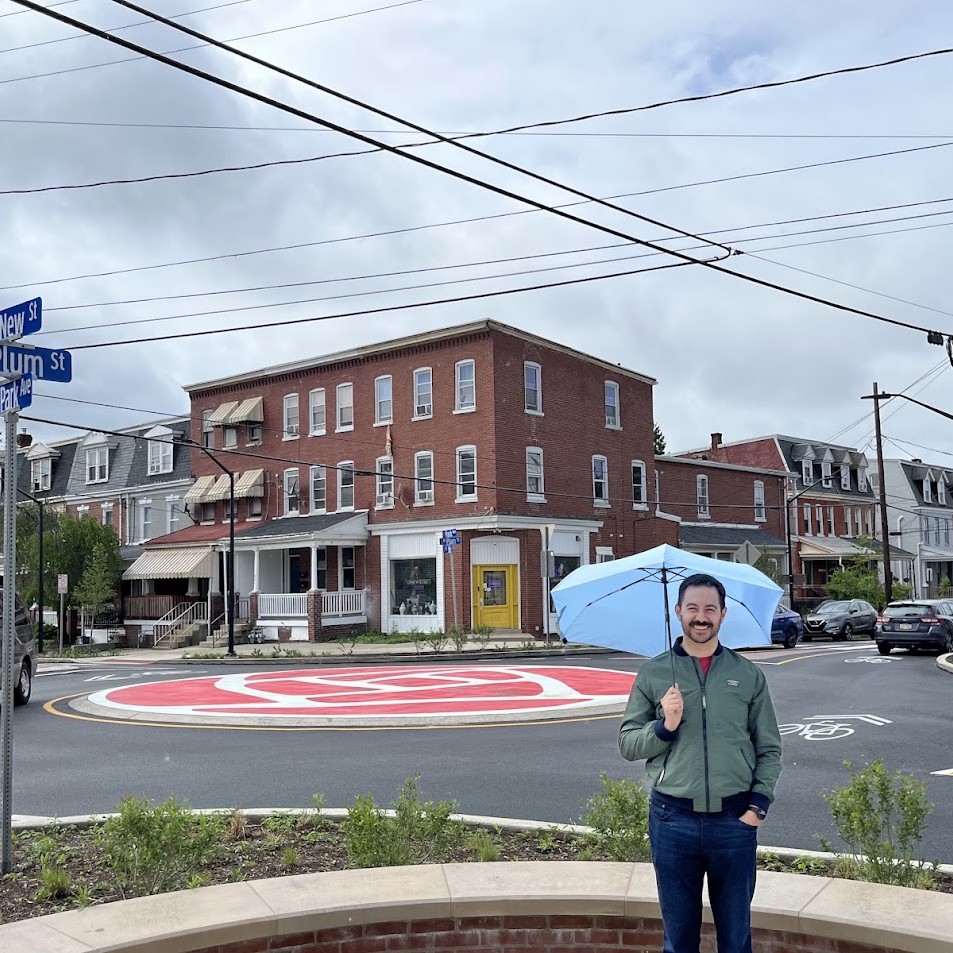
I’m also particularly proud of the Plum Street Roundabout in Lancaster. Although it’s a mini-roundabout in an urban neighborhood, it shows how thoughtful, context-sensitive design can deliver benefits beyond transportation. By repurposing excess pavement, the project helped create space that better serves the surrounding community.
What do you think the next decade of roundabout design will look like?
Looking ahead, I see several exciting trends shaping the future of roundabout design. First, roundabouts are becoming smaller and more efficient. Some early single-lane roundabouts were as large as 160 to 180 feet in diameter, which often added unnecessary cost. Today, agencies are looking for ways to reduce construction costs and minimize impacts while still delivering the same safety and operational benefits. We’re also seeing hybrid and multilane roundabouts become more compact as truck accommodations evolve through designs that allow larger vehicles to straddle lanes when needed.
Another important trend is the continued focus on creating more bicycle- and pedestrian-friendly roundabouts. While roundabouts are already among the safest intersection types for people walking and biking, there is still room to improve comfort and accessibility. Recent research and updated design guidance are helping practitioners better accommodate visually impaired pedestrians and create safer, more intuitive crossings for all users.
We’re also seeing the growing adoption of protected roundabouts for cyclists. Originally developed in the Netherlands, these designs provide dedicated space for people biking and have steadily gained traction in the United States. They’re now included in national bicycle guidance and are appearing in local design manuals and built projects across the country, including here in Philadelphia.
Finally, I’m keeping a close eye on turbo roundabouts. Developed in the Netherlands, turbo roundabouts use raised lane dividers and a spiral-shaped geometry to guide drivers into the correct lane before entering the roundabout. The design can help reduce certain types of crashes, and interest is growing as more states begin to pilot and implement these designs.
Fast Lane Facts:
Favorite roundabout anywhere in the world?
The Long Beach Traffic Circle. I grew up in Long Beach and everyone dreaded driving through “The Traffic Circle”. It wasn’t until I started working on roundabouts that I learned it was converted to a roundabout in the 90s. It’s been the source of a lot of lessons learned since then.
Single-lane or multi-lane?
Single-lane! Simpler, slower, and more capacity than you might think.
Truck apron: underrated or perfectly rated?
Underrated. We typically don’t let vehicles drive off the pavement and truck aprons allow us to accommodate large vehicles while slowing the small vehicles. Plus, we’re seeing outside truck aprons used more with conventional intersections.
Favorite roundabout fact?
Circular intersections got their start right here in the USA with L’Enfant’s circular plazas in DC and Columbus Circle in NY. Shout out to WSDOT’s social media.