
December 4, 2025

Over the last 36 years, roundabouts in the United States have become the go-to for many cities looking to make roads safer and travel more efficient. Currently, more than 11,000 roundabouts have been installed in the United States, and that number continues to grow.
It isn’t surprising: This proven traffic-calming measure can reduce fatal and serious injury crashes by up to 82% and reduce traffic delays and stops by up to 74%. Even so, agencies and communities often have important questions about what it will take to deliver a roundabout successfully.
Often, these critical questions concern time and money.
Building a conventional roundabout can take years, from planning and design to funding and full reconstruction. A lengthy process can also run up the price tag. While often less expensive to install than traffic signals, roundabouts can easily cost anywhere from $500,000 to $3 million.
But now a growing number of communities have discovered a faster, lower-cost solution: the quick-build roundabout.
A quick-build roundabout is a low-cost, modular version of a traditional roundabout that can be designed and installed on a much faster timeline. Using paint, flexible posts, prefabricated curbing, or 3D-printed materials, agencies can reconfigure an intersection within the existing roadway footprint. That means there is no need for major grading, drainage work, or new curbs, which can often become time-consuming and costly for a project.
Quick-builds embody a simple but powerful idea: Safer streets don’t have to wait.
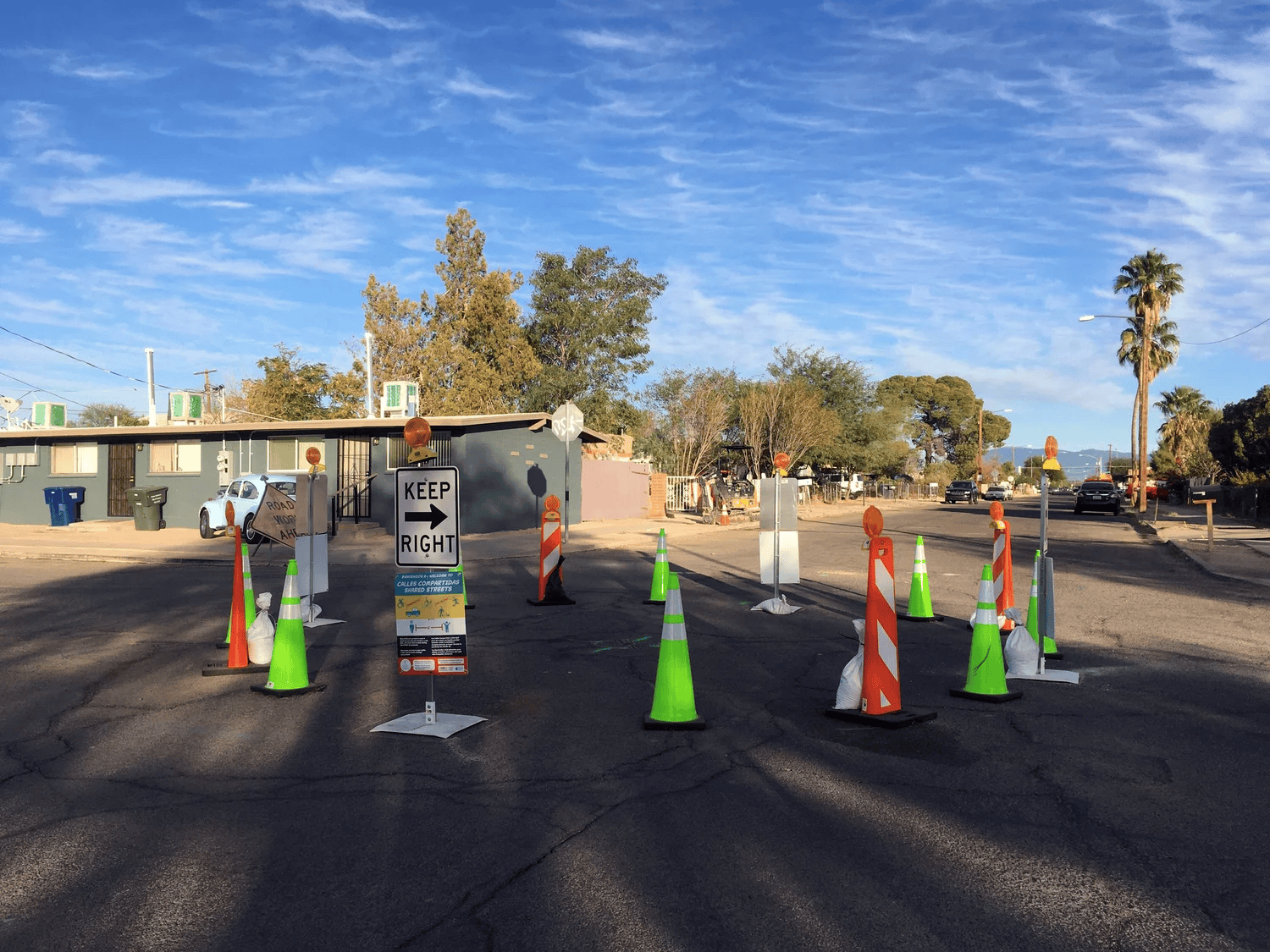
Made of just a few cones, sandbags, and signs, this temporary traffic circle helped residents observe driver behavior before deciding whether to install a more permanent traffic circle in their neighborhood. Photo credit: Living Streets Alliance
The Benefits of a Quick-Build
Communities don’t have to wait for full reconstruction projects to make intersections safer. Quick-build roundabouts let agencies test designs, gather community feedback, and deliver proven safety benefits faster.
Speed and Affordability
The most immediate advantages of a quick-build approach concern time and cost. Utility relocations, drainage improvements, and concrete work can quickly run up the bill for a traditional roundabout. Quick-builds avoid major curb moves and rely on simple, readily available materials, which means installation can happen far more quickly, often in just a matter of weeks.
Such speedy implementation makes quick-build roundabouts especially appealing to cities pursuing Vision Zero or similar safety initiatives, where dozens of intersections may require intervention. By reducing construction timelines and costs, agencies can implement several safety improvements for the price of one conventional project.
Flexibility and Iteration
Quick-build designs require less upfront time and cost because they use flexible, modular layouts and proven templates rather than extensive custom design work. Once installed, these materials can be adjusted or reconfigured based on observed traffic behavior and community feedback. This ability to test and refine in real time reduces the risk of costly design mistakes and encourages data-informed decision-making.
Safety and Accessibility
Roundabouts improve intersection safety by slowing vehicle speeds and clarifying priority movements. Quick-builds bring these same safety benefits to a community but on a much faster timeline than a traditional roundabout. While quick-builds might lack permanent curbing or landscaping, they still reduce conflict points and create safer conditions for people walking and biking. Like standard roundabouts, they can also be designed to accommodate transit vehicles and emergency responders.
Building on the benefits of quick-build roundabouts, agencies are also working to integrate features such as quick-build curb ramps, protected bike lanes, and accessible crossing treatments to ensure that even temporary installations meet ADA standards and support travelers of all abilities.
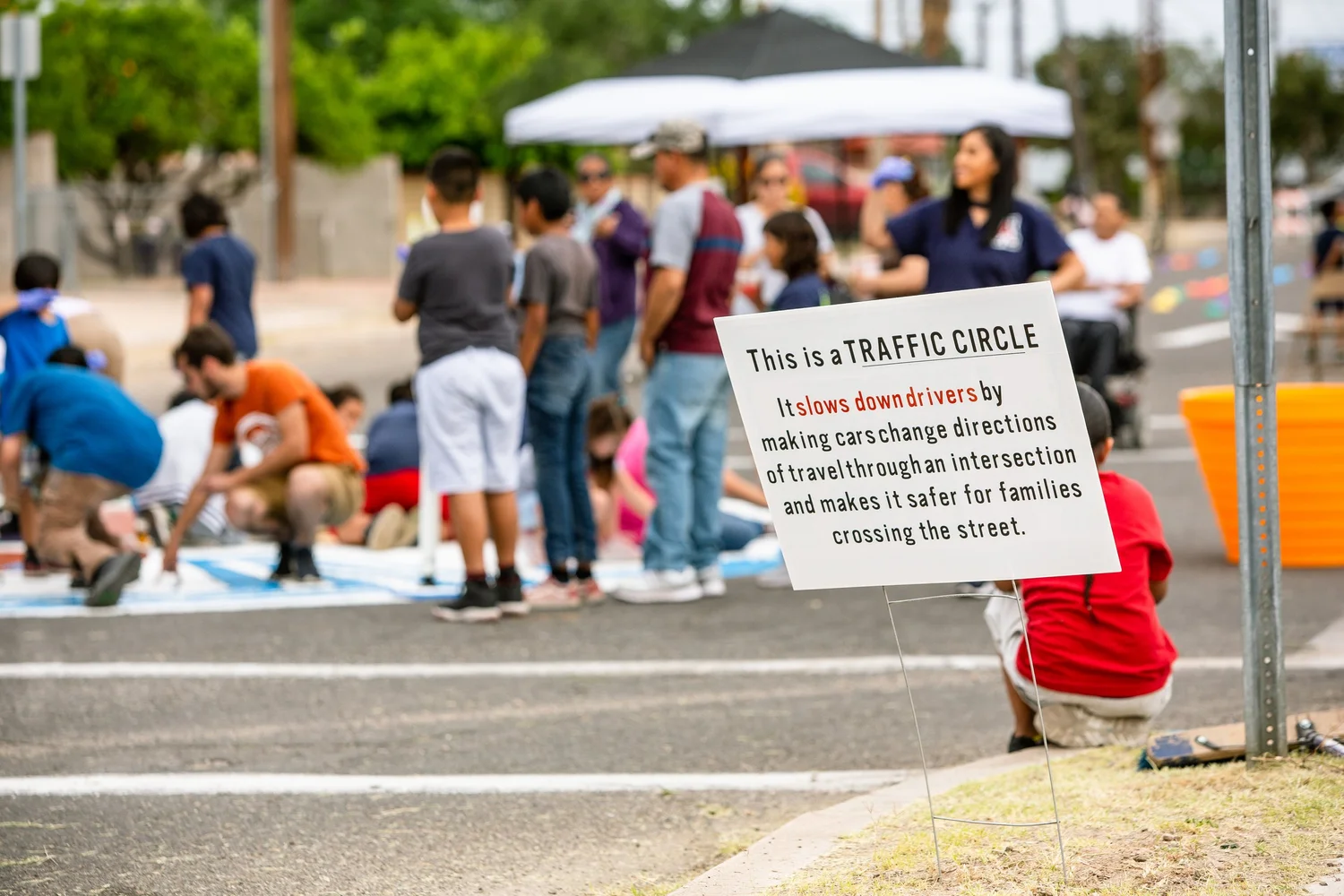
Quick-builds of all kinds bring safety benefits to communities on a much faster timeline. And as this traffic circle in Tucson, Arizona demonstrates, quick-builds can be a wonderful opportunity to involve the community in construction. Photo credit: Living Streets Alliance
Quick-Builds in Practice
Kittelson is proud to partner with several agencies leading the way in testing and refining quick-build roundabouts at scale.
In Washington, D.C., the District Department of Transportation (DDOT) has implemented many quick-build projects as part of its broader traffic safety strategy, including several quick-build roundabouts at prominent intersections. At one intersection near the U Street Corridor, a confusing four-leg junction was transformed into a compact roundabout using paint and flexible posts. The change simplified the intersection, clarified traffic flow, and significantly reduced conflict points at minimal cost.
In San Diego, the city has incorporated quick-build design into its Safe Streets for All (SS4A) program. After the City constructed two initial quick-build roundabouts, Kittelson worked with staff to capture lessons learned and translate them into a refined, standardized template that engineers can adapt to hundreds of intersections identified as high priority through a systemic safety analysis. The City uses 3D-printed modular curbs and painted surfaces to define travel lanes, protected bike lanes, and pedestrian crossings, keeping costs low while ensuring durability. The team is also developing quick-build curb ramps, which help lower costs further and make the installations more accessible. Together, these efforts support a broader strategy to deliver rapid safety improvements citywide without waiting for long-term capital funding.
Both D.C. and San Diego have demonstrated that quick-build roundabouts can perform effectively for many years. For example, in San Diego, the City installed a quick-build roundabout at a four-way intersection at Del Sol Boulevard Kostner Drive in 2024 using 3D-printed red boards for curbing and paint for other channelizing elements. This is just one example of “quick-build” not meaning “temporary.” There is no plan to install a traditional roundabout at an intersection that formerly saw a high number of crashes because the quick-build model is expected to function as a long-term solution with proper maintenance.
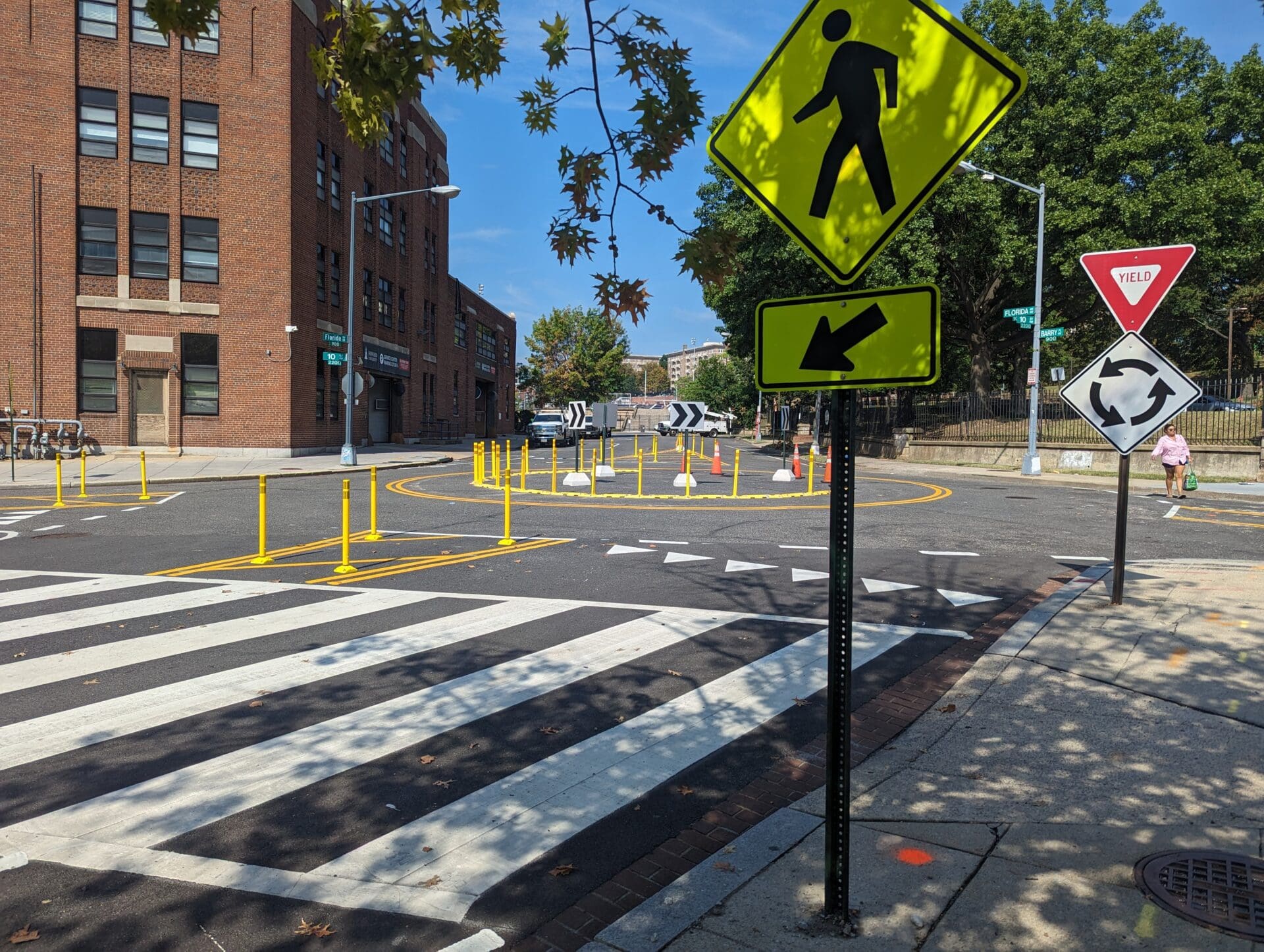
In Washington, D.C., the quick-build roundabout at Barry Place, Florida Avenue, and 10th Street began with initial skepticism during construction, but now the community response has been overwhelmingly positive. As a result, DDOT is replacing the modular curbs with permanent curbs in 2026.
In Washington, D.C., the quick-build roundabout at Barry Place, Florida Avenue, and 10th Street also integrated a ground mural from a local artist. After some initial skepticism during construction, the community response has been overwhelmingly positive. As a result, DDOT is replacing the modular curbs with permanent curbs in 2026.
So, You Want to Implement a Quick-Build Roundabout—What’s Next?
While these modular roundabouts offer many advantages, they also require careful planning to ensure long-term success.
Here are the top five considerations for agencies to think about:
- Site selection: Not all intersections would benefit from a quick-build roundabout. They tend to work best where existing curb lines can remain untouched, and where traffic volumes, turning patterns, and available space allow for a circular configuration without major reconstruction.
- Maintenance and durability. Materials vary widely in lifespan and maintenance needs. Painted markings and flex posts may require frequent touchups, while modular plastic or 3D-printed elements tend to last longer. In San Diego, staff within the maintenance department have developed the skills and workflows needed to assess quick-build materials, replace elements as they wear, and keep installations performing as intended. This dedicated attention helps ensure quick-build projects remain safe and effective over time.
- Climate and environment. Cold-weather cities must plan for snow removal, drainage, and debris management. While modular materials perform well in most conditions, designs should account for plowing and runoff to avoid damage or pooling.
- Procurement and policy. Many municipal procurement systems are structured for traditional construction, which can make it difficult to purchase nonstandard quick-build materials. Establishing a “quick-build toolbox” and flexible contracting processes allows agencies to test and iterate more easily.
- Evaluation and community feedback. Measuring success is key. Cities should collect before-and-after data on vehicle speeds, crash rates, pedestrian crossings, and driver yielding behavior. Gathering community feedback also helps refine future designs and build public support for permanent improvements.
A Smart Step Forward
As construction costs rise and agencies continue to focus on making their streets safer, quick-build roundabouts are becoming an increasingly practical solution. They allow cities to make meaningful safety improvements immediately, learn from real-world performance, and invest wisely in permanent infrastructure over time.
Cover image credit: Living Streets Alliance