Challenge
The City of Rufus, Oregon, is a small but growing recreational destination nestled along the Columbia River. The city is home to about 250 residents who need a transportation system that supports their community. Currently, there are no sidewalks, bike lanes, or safe crossings; as it is, people who want to walk or bike along 1st Street have to share the road with freight trucks and through traffic. The railroad and I-84 compound the problem by creating a physical barrier between the downtown commercial area and the waterfront.
Community members see real potential in a more vibrant downtown that better connects the waterfront and the commercial core. The Community seeks a solution that will support local businesses, strengthen Rufus as a regional destination, and create more access to the waterfront.
Solution
To address these challenges, the City pursued an ODOT Transportation and Growth Management (TGM) grant to develop a plan that would chart a path toward a safer, more connected, and more vibrant Rufus. Our team developed a two-part plan—an Active Transportation Plan (ATP) and Street Design Standards—through a collaborative process that included walking tours; pop-up events; an open house; and an advisory committee of elected officials, residents, business owners, and state and federal agency partners.
The ATP identifies a prioritized set of 15 site-specific projects that address walking, biking, wayfinding, traffic-calming, and connectivity throughout the city. For the two highest community priorities, 1st Street and Main Street, Kittelson developed detailed planning-level concepts that show how new sidewalks, buffers, enhanced crossings, and streetscape improvements could be implemented to meaningfully improve mobility, comfort, and safety for all users.
The Street Design Standards establish clear technical parameters for all future roadway construction and reconstruction in Rufus to make sure that new infrastructure consistently supports all users, including pedestrians, bicyclists, and motorists, while preserving the city’s small-town character.
Kittelson also created 3D visualization cross-sections for each street type to bring the design standards to life, help the community visualize what the improvements could actually look like in their neighborhood, and advance pedestrian and bicycle options that truly fit the context and character of this unique community.
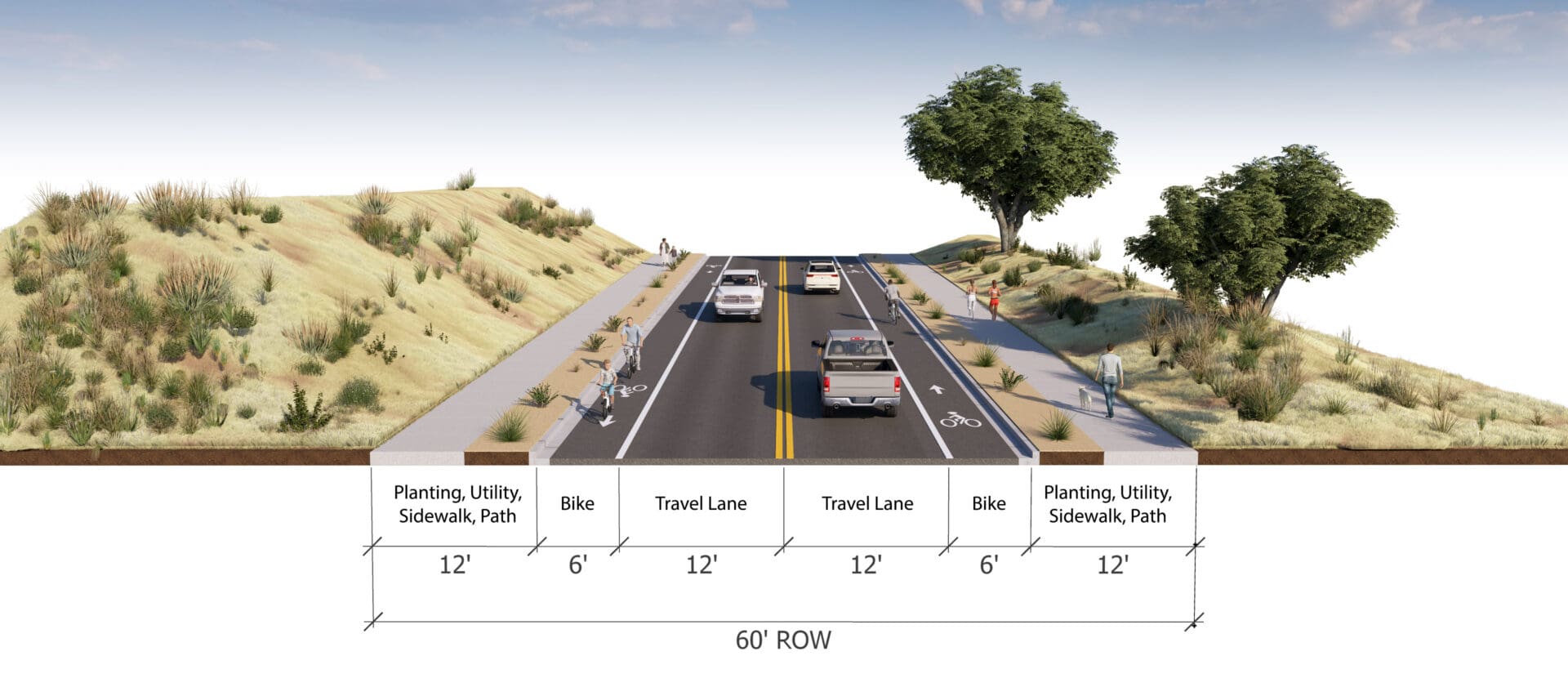
Source: Kittelson & Associates
The Outcome
Supporting Small Town Mobility in Rufus, OR
The plan equips Rufus with a realistic, phased path forward that meets the community where it’s at. The plan acknowledges existing financial constraints while building on the strong community pride and potential that already exists. By identifying potential state and federal funding sources, and by outlining the policy and code amendments needed to align the plan with county and state frameworks, the work positions Rufus to compete for state and federal grants it previously lacked the planning foundation to pursue.
Over time, implementation of the priority projects will make it safer and easier for residents to access parks and community amenities and for visitors arriving from I-84 to find their way to local businesses and the waterfront. This supports the local economy and strengthens the quality of life for everyone who calls Rufus home.