
October 7, 2026

The truth—and value—of working outside one’s home country is that, even when you’re acting as the “expert” of a subject, you end up learning as much as you teach. International projects are so gratifying in part because they make literal transportation planning’s fundamental conundrum: while a planner can know what’s best for every community from the comfort of their desk, they can never know what’s best for any single community until they immerse themselves in its place and people. Even when we conduct work in the communities we call home, we don’t presume to know the prevailing attitudes or precise needs of the community at large; to gain those insights, we need to experience both infrastructure and culture on the ground.
The difficulty of knowing what will help a community only increases when that community lives halfway around the world, in a place you’ve never been. This was the challenge that presented itself in 2023, when staff from our Boston office teamed up with CDM Smith to begin developing a Bicycle Master Plan for the nation-state of Qatar. With the plan now published, we wanted to write about our time working in Qatar, both to discuss the inevitable need to reattune one’s perspective when working in a new place and to champion the importance of pivoting with humility to meet client and community goals.
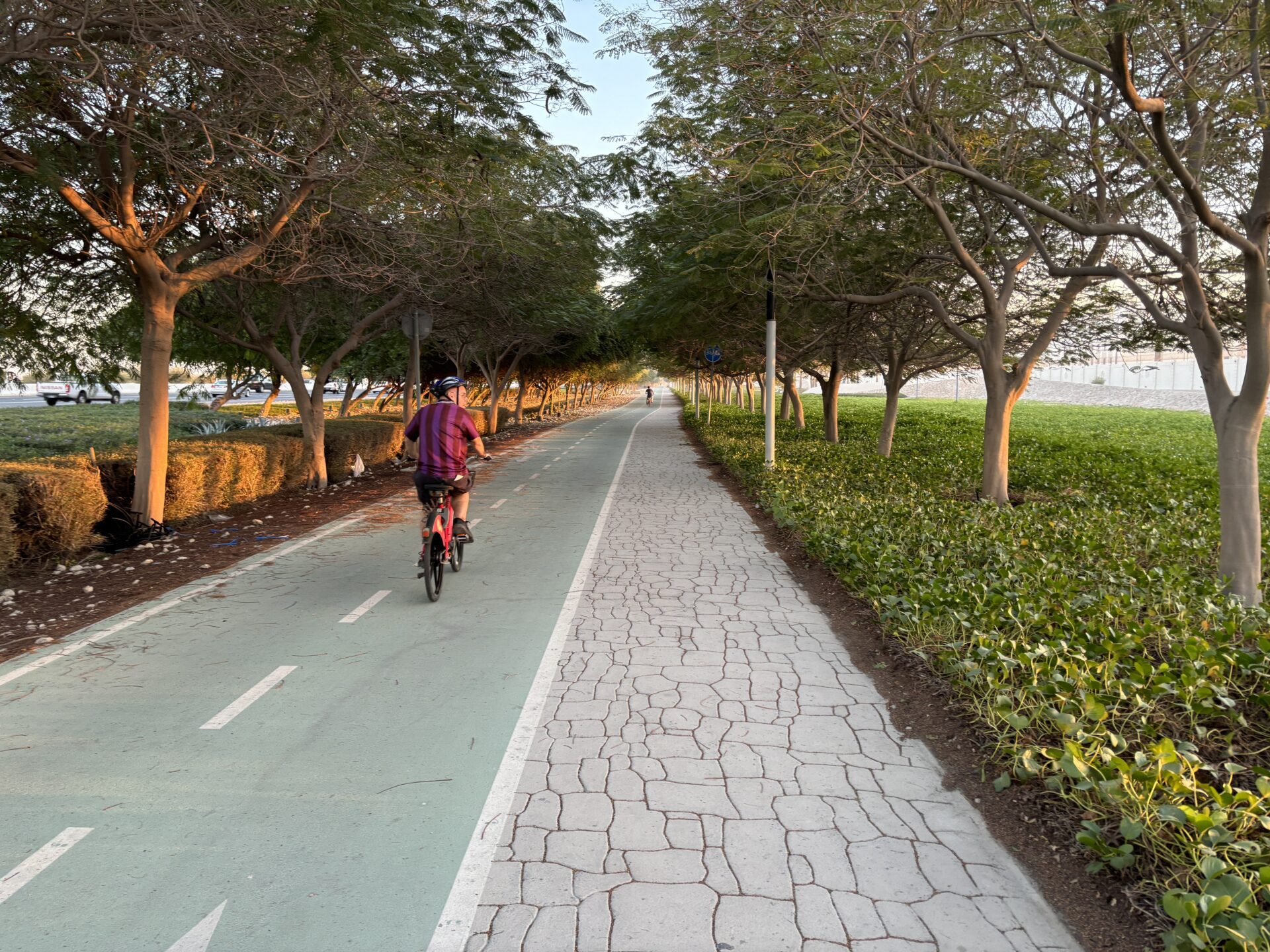
One of the many high-quality, dedicated bicycle paths in Qatar. Source: Conor Semler
A Postcard from Doha
In addition to the fact that we were working in a new setting, the project itself—a plan that will govern the development of bicycling and micromobility infrastructure for an entire country through 2050—was unusual to our staff. While we regularly conduct nationally relevant research at home, when it comes to writing plans, we’re more accustomed to working at the statewide, regional, or municipal scale. But we quickly came to understand how the unique traits of Qatar make a nationwide Master Bicycle Plan not just possible but desirable.
The modern state of Qatar is young: though people have inhabited the land for millennia and the territory has existed at different points under the rules of Portuguese, Bahrain, Saudi, Ottoman, and British governments, Qatar eventually became the state it is today when it emancipated itself in 1971. It’s also a wealthy country: in the decades since it gained independence, the Qatari government has used its abundant oil reserves to become one of the highest income per capita countries in the world. Lastly, Qatar is also physically tiny. Covering 4,471 square miles, it’s about 80% the size of Connecticut, with most of its approximately 2,800,000 (and growing) population concentrated in Doha, the capital city.
In other words, Qatar has spent much of the twenty-first century redefining itself as an independent actor on the world stage; unlike many other developing countries, however, it has had the tools to do so with remarkable precision. Its concentrated population and young government have kept its bureaucracy lean even 50 years on. Consider how the U.S. has thousands of transportation authorities spread across its federal, state, regional, and local jurisdictions. Now consider how these authorities, in order to exercise their duties, need to collaborate with one another both vertically—as when a state DOT applies to FHWA for HSIP funding to maintain its highways—as well as horizontally—as when an MPO coordinates a Regional Safety Action Plan using input from several co-equal local jurisdictions that neighbor each other—in ways that extend processes exponentially. Qatar has exactly one transportation planning authority (the Ministry of Transport) that is vested with the power to make decisions for the country’s entire transportation network—a responsibility underwritten by the country’s considerable wealth and only feasible due to the country’s small size.
For all of these reasons, Qatar is uniquely able to create a single, coherent vision for the role bicycling should play throughout the country. The Ministry of Transport was interested in a Bicycle Master Plan as a step toward becoming a global capital for bicycling. Visit Qatar, the marketing arm of Qatar Tourism, advertises the country as a place with “miles and miles of paths for the country’s growing number of cyclists.” Its web page on cycling lists nine highly visible, state-of-the-art separated bicycling facilities that cater to all skill levels, including Olympic-quality tracks. Historically, however, native Qataris have not considered bicycling to be an effective or desirable mode of transportation, and especially not for women or children.
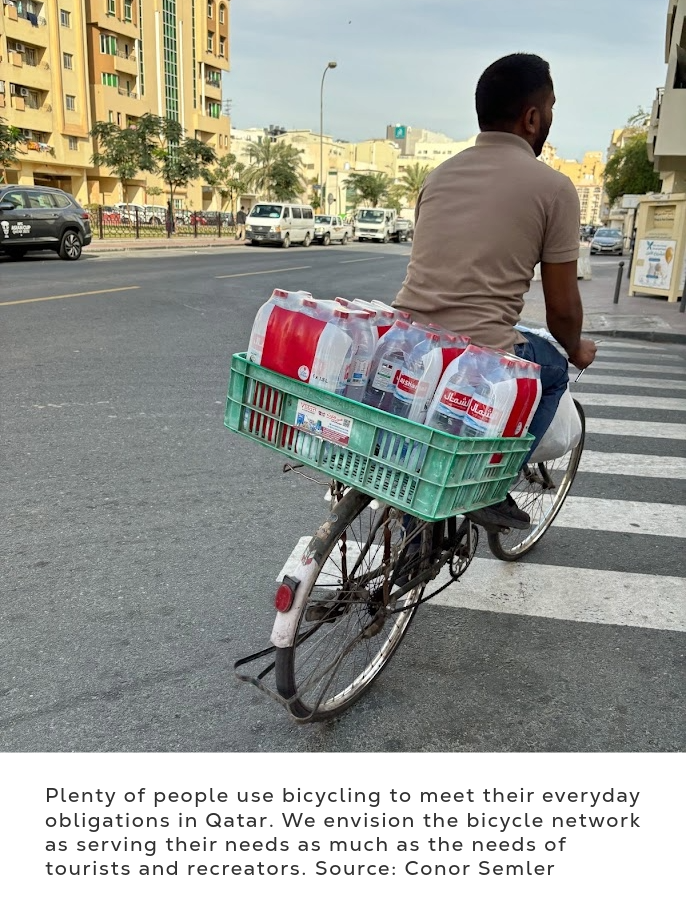 This doesn’t mean there are no bicyclists in Qatar. In fact, bicyclists are everywhere—they just may not be native Qataris. Most of the country’s inhabitants hail from elsewhere. According to the Migration Policy Institute, about 88% of Qatar’s total population consisted of foreign nationals as of 2022. These people migrate to the country to work largely as laborers and have played a huge role in the rapid modernization of the country. These expatriates also happen to come overwhelmingly from countries like India, Bangladesh, and Nepal, where bicycling is a popular mode of everyday transport, and these individuals often continue to rely on bicycling to get around Qatar.
In other words, Qatar currently has a lopsided relationship to bicycling: though bicycling is lauded for recreation and fitness, it suffers a poor national reputation for day-to-day travel, even as many people in Qatar are, in fact, bicycling every day and everywhere. When we were invited to join CDM Smith to serve as the bicycle and micromobility experts for the plan, we hoped to bridge the gap between what bicycling means in the Qatari imagination and how it’s actually used by its inhabitants. Together, the Ministry of Transport and the project team expanded the scale of its vision to include both premium separated bicycle lanes and the infrastructure to make trips safer, more comfortable, and more connected for the people already cycling in Qatar today.
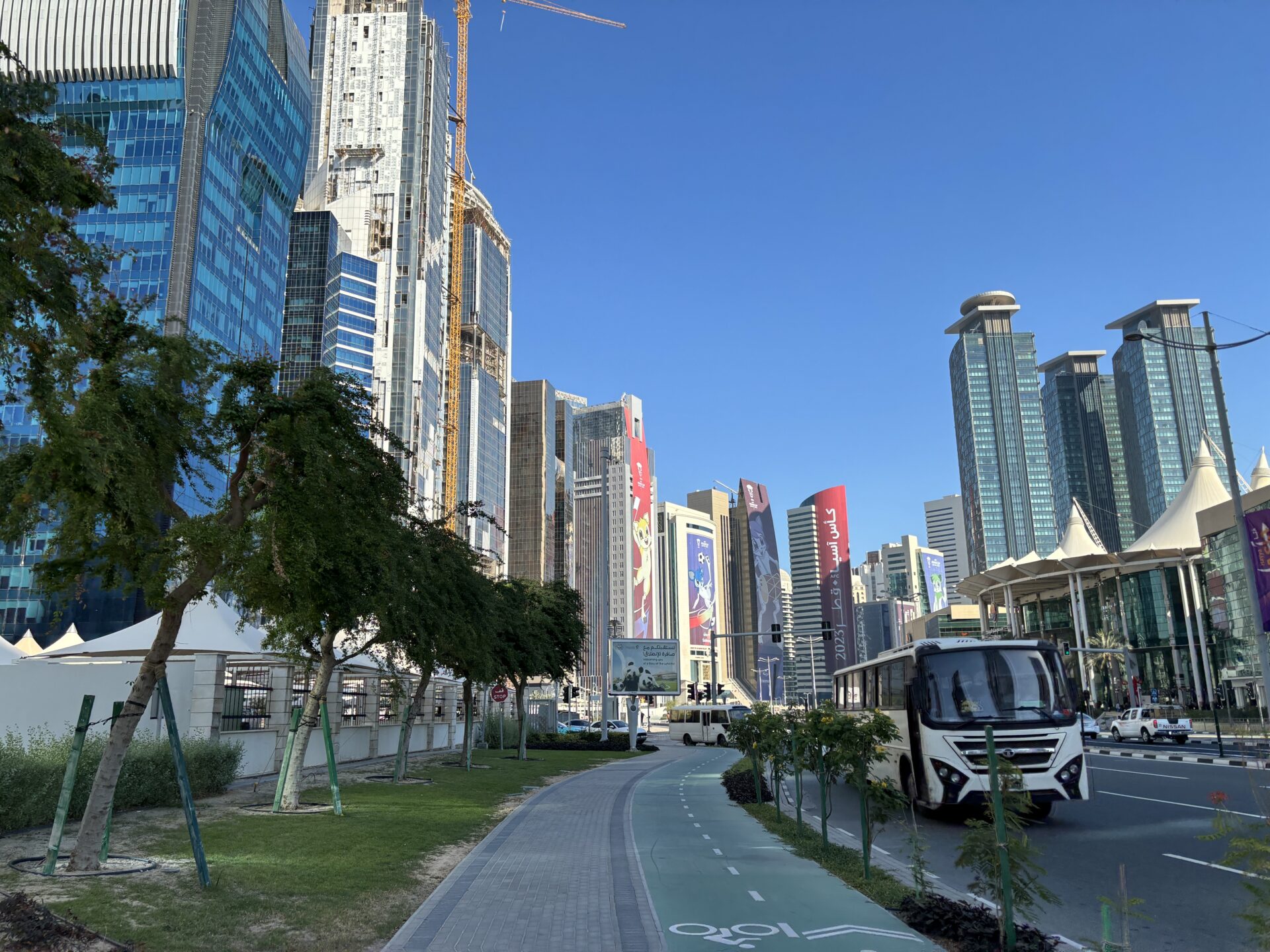
Part of the work of making bicycling acceptable is making it visible. The first step to improved visibility was to identify what challenges exist that downplay the presence of the bicycling that’s already happening. Source: Conor Semler
Helping to Make Qatar a Bicycling Capital
To build a master plan that positions bicycling as a standard transportation system need instead of simply a recreational activity, we wanted to first engage with the standing views of bicycling in Qatar. Our first contribution was to work with the Ministry of Transport and CDM Smith to develop a comprehensive document of challenges standing in the way of widespread bicycle acclimatization as well as tools that could help to address them. By touching every aspect of society, from policy and educational programming to project development and infrastructure, we created a framework of strategies to guide the rest of the plan toward making bicycling more acceptable by making it more visible (and vice versa). The resulting document was intentionally not the final Bicycle Master Plan; instead, the exercise was exploratory in nature, drawing on international examples, and intended to help the team wrap its arms around the enormity of the task ahead.
We also used data harvested from large-scale fieldwork to perform a short-trip opportunity analysis, a type of future conditions analysis designed to model how the plan’s recommendations could encourage widespread mode shift for trips less than 5 km (or about 20 minutes). The Ministry of Transport has the development of the country’s transportation infrastructure plotted for interim horizons through 2050, and our modeling of the mode shift mirrors this.
Finally, we led the development of bicycle and micromobility network and infrastructure planning guidance as part of a larger Qatar Bike Infrastructure Planning and Design Guide, which means that our master plan contributions were not place specific. Rather, we attempted to incorporate the best practices from a range of bicycling role models, including the United States, the United Arab Emirates, China, Vietnam, France, the Netherlands, Australia, New Zealand, and Canada. CDM Smith, meanwhile, oversaw the development of all design content (including place-specific network recommendations). Then we led the effort to merge these two halves into a single, comprehensive guide.
The Upside of Disorientation: A Perspective Refresh
Our two years working with the Ministry of Transport and CDM Smith forged a true intellectual partnership. Again and again, the most thrilling moments of the project were those that challenged our preconceived notions of what transportation decisions to make and how. It’s one thing to plan for a bicycle network in a desert nation; it’s another thing to plan for a bicycle network in the specific desert nation of Qatar. Only our firsthand exposure to the place provided us with the answers we needed. Here are three major lessons we learned:
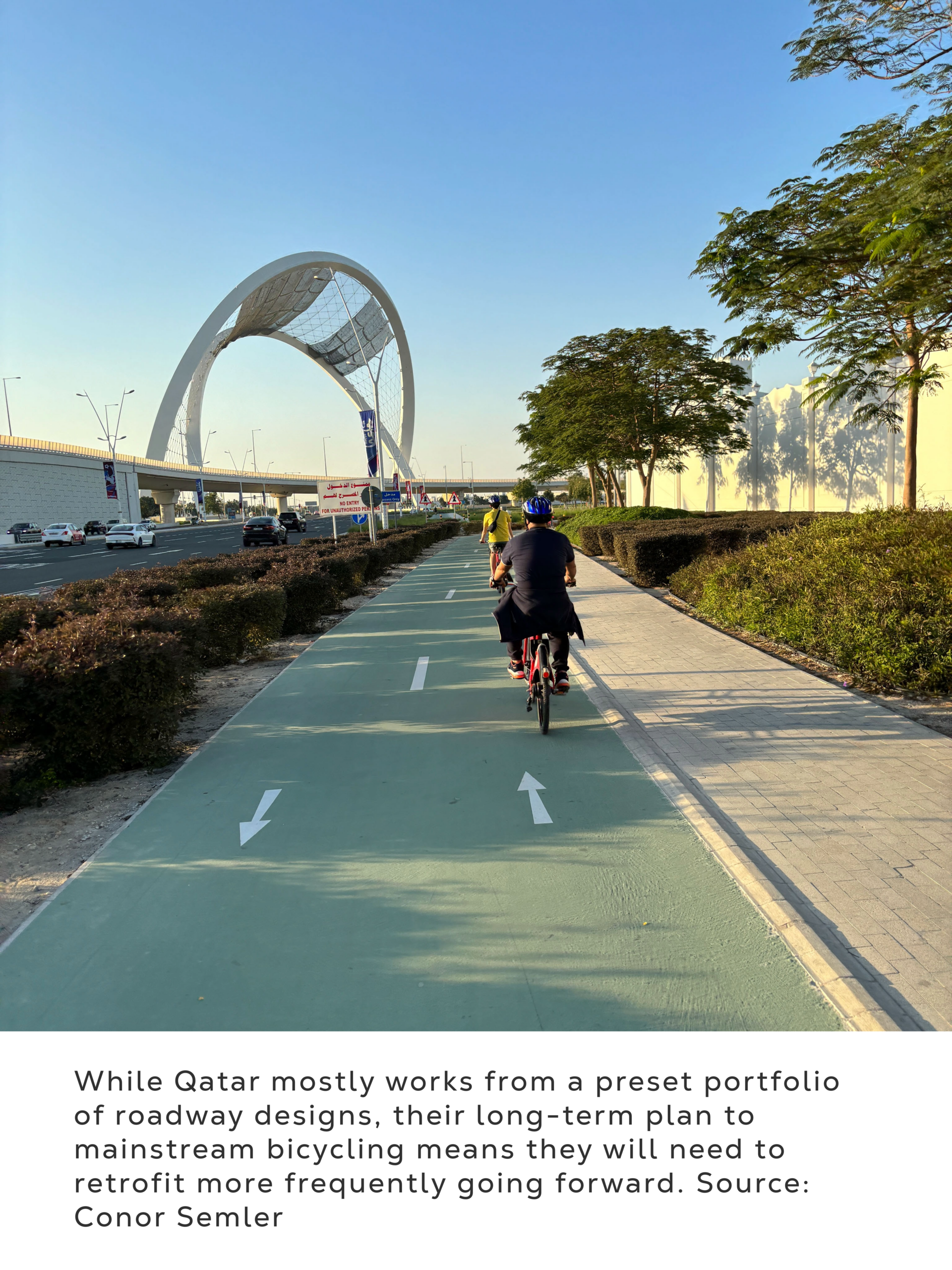 We needed to find alignment between two different approaches to design.
In the urban contexts of the U.S., we largely deal with retrofitting in constrained conditions. In Doha, many roads have been designed afresh in recent years and are in compliance with a set portfolio of preestablished designs. This coherence means that there is an expectation in Qatar of being able to achieve a desired typical section in a way that isn’t feasible in the crowded, narrow streets in northeastern American cities like Boston or New York. As a nation, however, Qatar is starting to have to deal more and more with the reality of retrofitting, including for the Bicycle Master Plan. We were excited to share what we’ve learned about using design principles to allow for thoughtful flexibility and strategies for thinking about tradeoffs.
A different traffic law posed unexpected design challenges.
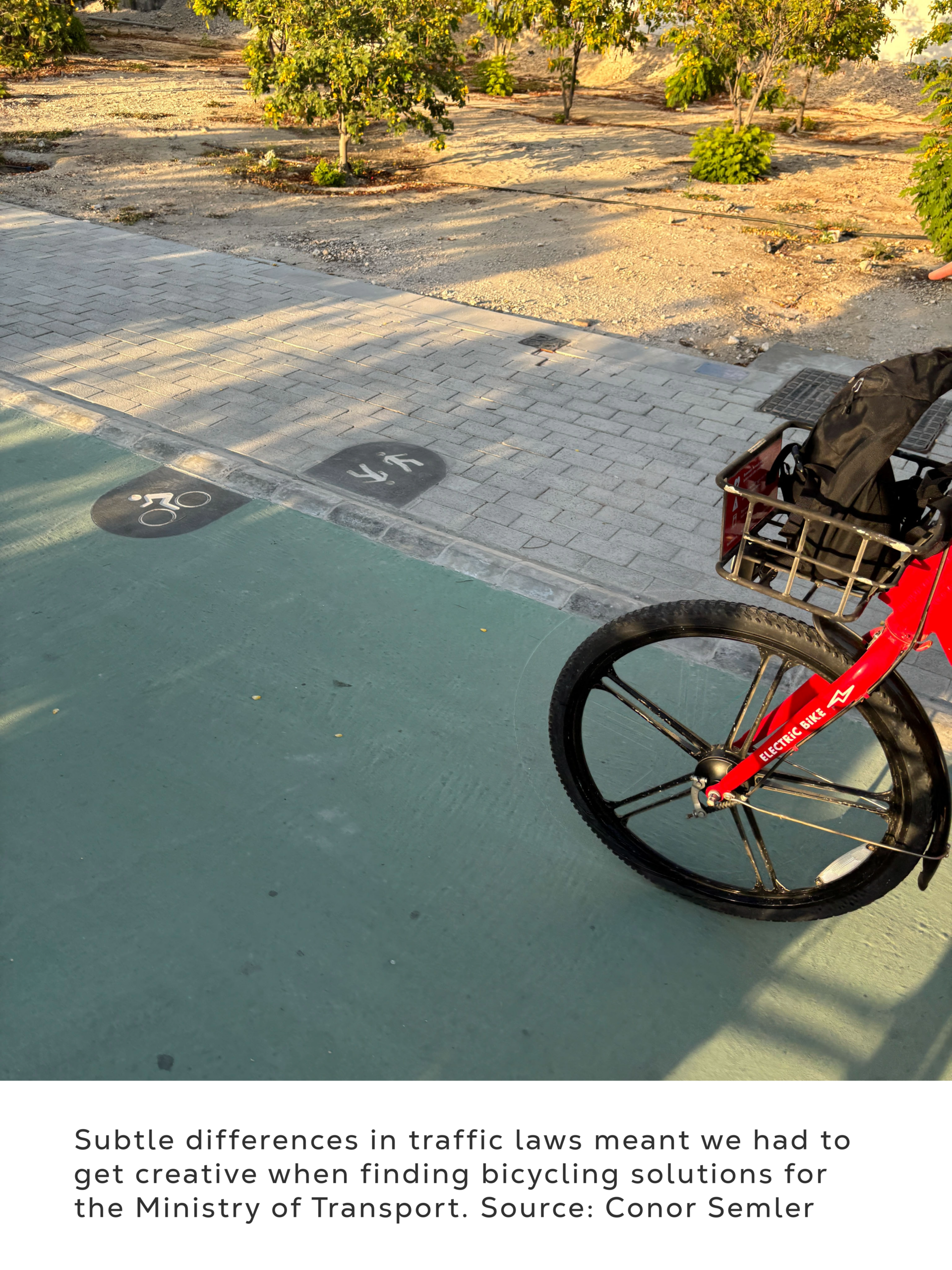 As of this writing, our project contributors have made four trips to Qatar. In between those trips, we’ve done the work of any subject matter expert worth their salt, from reviewing the existing literature on bicycle infrastructure to studying comparable bicycle networks to preparing our recommendations for Master Plan. In-person meetings became opportunities were we could collaborate with members of the Ministry of Transport and CDM Smith to work through the innumerable variables that wouldn’t naturally present themselves to us in our chilly Boston office.
For example, during one of these trips we discovered that several tried-and-true American bicycle facilities (facilities that initially featured prominently in our research) don’t translate to Qatar because of a traffic law that makes it illegal for traffic to proceed straight through a turn lane. Because the Ministry of Transport conceives of bike lanes as through lanes, bike lanes can’t occupy the rightmost stretch of right-of-way through an intersection because this would place through bicyclists in conflict with right-turning vehicles. In other words, the bike lane implementation most common here is an impossibility there.
Similarly, protected intersections, which separate different modes by time, don’t exist as a concept on Qatari roadways, where designers tend to separate different modes by providing them with entirely different facilities, like a shared-use path or a sidewalk adjacent to the road. Ultimately, we still included the facilities such as protected intersections and on-street bicycle amenities as forward-facing options should the Ministry of Transport change its approach to intersections.
We contended with a different climate—and benefitted from an expanded oversight of infrastructure.
Finally, the centralized nature of decision-making in Qatar yielded some real advantages to the planning process. The master plan contained a specificity and breadth amongst its facility recommendations that would be impossible to enforce in the United States. To contend with the intense desert heat (summer days in Doha regularly reach 105 Fahrenheit and can be even hotter), the Ministry of Transport was adamant that its master plan contain guidance for standardizing the presence of trip-supportive facilities like drinking fountains, mist sprays, and shade structures along bike routes. The guidance also considers how Qatar’s heat will impact the user experience at places of delay (like at signalized intersections) as well as how different construction materials will endure the climate.
Traveling Far to Find Planning’s Deepest Values
The differences between planning in the United States and in Qatar, while sometimes expected and sometimes surprising, required us to work with our partners to find fresh solutions to known transportation riddles, to shed the notion that there’s a singular “best practice,” and to understand that presently unavailable solutions could become available with time. Throughout the project, we had to readjust our thinking and challenge our assumptions, and it’s this work—the work of reattunement—that ultimately allowed us to productively support the project team in creating this plan.
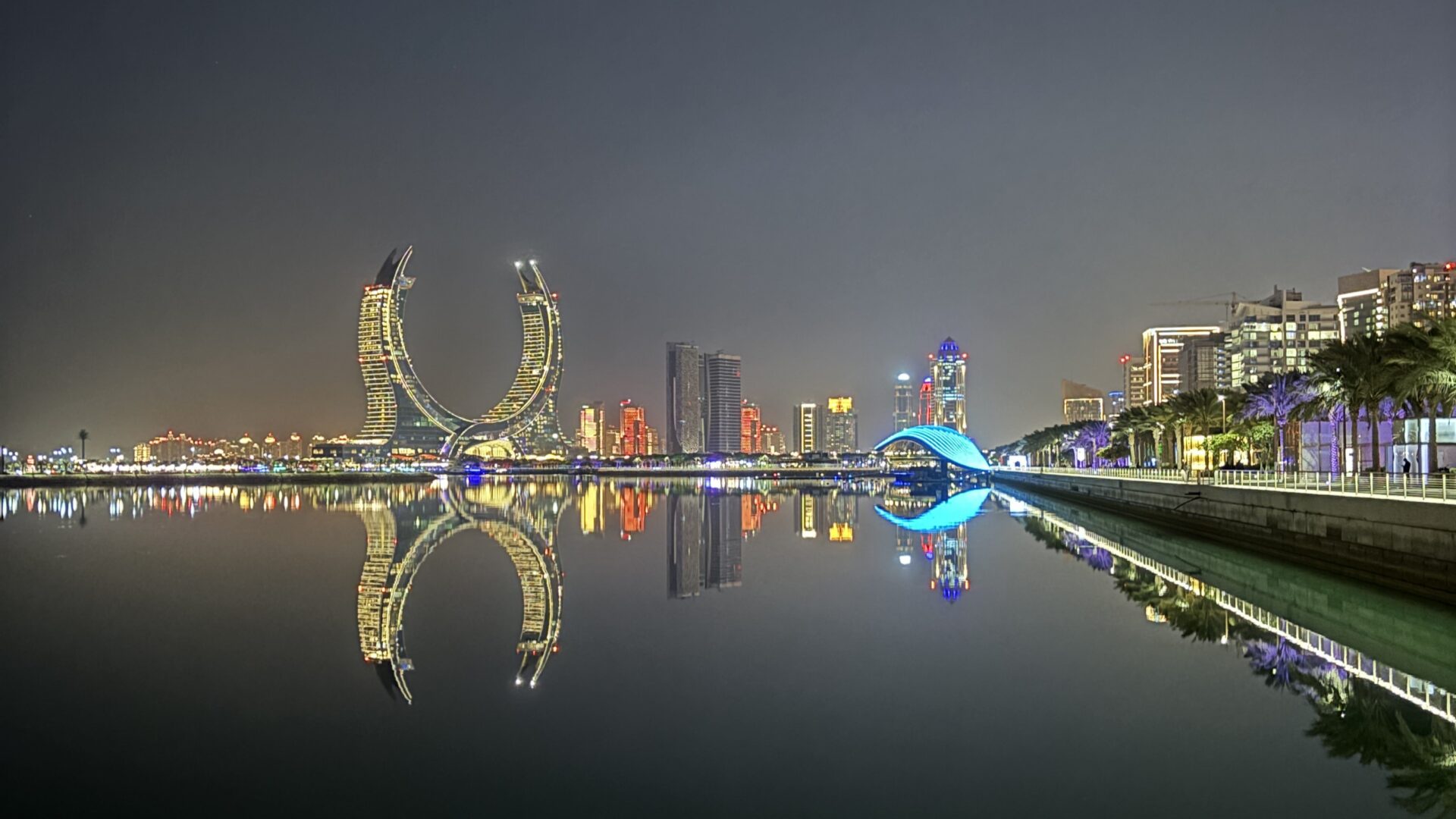
You receive as much as you give when you leave home for work. Source: Conor Semler
We’re so grateful for the opportunity to work with the Ministry of Transport and CDM Smith on a project that provided such a clear reminder of what really matters in planning. While in the United States we proudly design around technical principles like safety, sustainability, and adaptability, these values do not form the core of planning. They’re animated by a second, deeper-held set of human values like openness, curiosity, empathy, and compromise—these are the principles that form the universal backbone of planning and that allow planners working in Kittelson’s Boston office to travel across the world and have something of value to offer to professionals at the Qatari Ministry of Transport. The maximal disorientation of working in an unfamiliar place is invaluable precisely because it pierces through cultural norms and practices to arrive at this second layer of truth: that by experiencing any community firsthand and respecting it for its challenges and advantages, planners have the capacity to lend a hand to every community, anywhere.