
March 25, 2026

This September will bring about the end of the 2026 federal fiscal year, and with it, the end of the funding for several grant programs authorized under the Infrastructure Investment and Jobs Act (IIJA). Also known as the Bipartisan Infrastructure Law (BIL), this 2021 bill has funded grant programs that have provided more than $495 billion to transportation projects as of January 2026.
Federal grant programs like those powered by the IIJA play a central role in getting transportation-related projects all the way through the implementation phase. The Urban Institute notes that although “federal funding represents about a quarter of US public infrastructure spending,” the legislation that greenlights federal funds still “helps shape the nation’s infrastructure priorities because many federal grants require a ‘match’ from other levels of government.” In other words, if federal funding doesn’t account for the entirety of a project’s funds, it tends to form the spine that determines how all of the project’s other funding mechanisms hold up.
The critical role of federal funding explains why the expiration of IIJA-powered grant programs can feel like a substantial setback to the work of expanding and renewing the nation’s transportation infrastructure. While the BIL will remain in place as law, and while it’s likely that some of the transportation funding provided by IIJA will be replaced by Congress in some fashion, it’s unlikely for a host of reasons that this will happen quickly. In some cases, jurisdictions are already feeling the effects of the funding landscape’s tectonic shifts, with some communities finding that funds they were expecting have been cancelled or entire grant programs scrapped outright without any indication of what their forthcoming replacement programs will look like. And given the fact that pressures (such as the federal government decreasing its overall share of spending on infrastructure, as well as rising maintenance and operations costs post-COVID) have emerged to strain even a windfall as unprecedented as IIJA, it’s natural to feel nervous about the prospect of making do with even less.
The Only Constant Is Change
To start, we can take a deep breath and remember: we’ve been here before. As NCHRP Research Report 1004 reminds us, the story of federal transportation funding has been one of decades-long uncertainty. “Funding uncertainties were significant between the passage of ISTEA in 1991 and the enactment of the [FAST] Act in 2015,” according to the report. “During that time, there were 76 months—more than 6 years—without an active transportation authorization act.” (The nonprofit Transportation for America picks up the timeline where this NCHRP report leaves off, noting that since FAST’s passage, there have been an additional 14 months where funds were only committed through short-term extensions before IIJA’s eventual passage in 2021. In other words, “the federal transportation program has operated on a short-term extension” for 7.5 out of the last 23 years, or “a third of the time since 1997.”)
With our industry facing the imminent expiration of IIJA, it’s important to remember that funding setbacks are no different from any other type of hurdle your project might encounter. Just like discovering there are protected wetlands in your project area, navigating financial shortfalls is a part of the project implementation process, not an exception to it.
As such, it’s good during these periods to return to the basics that propel all project work forward. What built-in capacity do you have? What partners can you tap for needed resources? As the funding landscape shifts beneath our feet, let’s look at why having a Plan B that can help you work through your pause is actually just part of having a Plan A.
How to Work Through the Pause
Anticipate funding pauses—and prepare for them.
When your project experiences a pause—funding-related or otherwise—consider it an opportunity to return to the overall vision guiding your work. What core values are you trying to advance through the project that was paused?
With these values fresh in your mind, turn to your backlog. Are there other projects that promote the same (or similar) values that might be easier to implement in the current moment? If you’re not sure what projects would form your backlog, consider updating (or creating) your community’s anchoring documents like your Long-Range Transportation Plan, Comprehensive Plan, Safety Action Plan, or other community-wide transportation plans. The process of updating these documents will require you and your local partners to consider what’s important to you (both today and in the coming years), to identify locations in your transportation network where safety gaps exist, and to pair these locations to a toolbox of implementable safety countermeasures—voila! This is your backlog to fall back on the next time you encounter an unexpected pause.
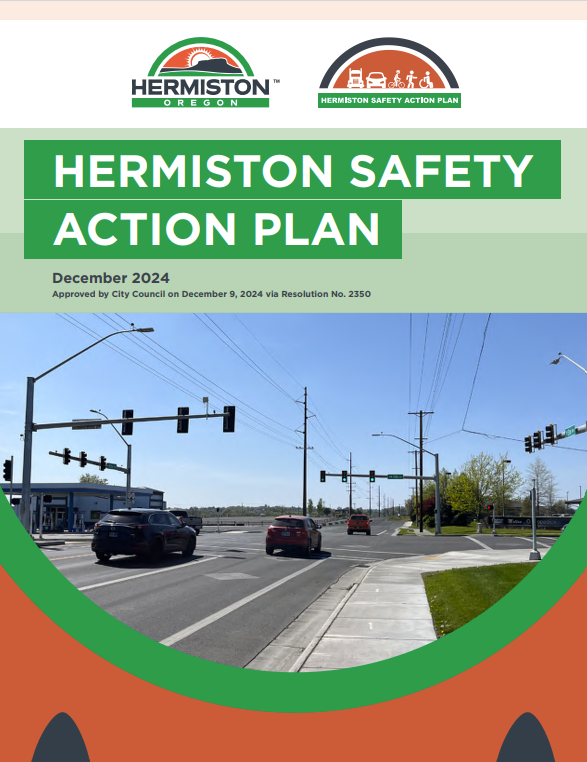
Guiding documents like a Safety Action Plan (pictured above) can help keep a community—in this case, the community of Hermiston, OR—on track to realize a unified vision of transportation over long stretches of time. Source: City of Hermiston.
Start where and when opportunity strikes.
In recent history, philosophies like the Safe System Approach have lived at the heart of the transportation practice; and multimodalism—designing and building roads that work for people no matter how they choose to travel—lives at the heart of the Safe System Approach.
So it can seem unfashionably behind the times—even counterproductive—to implement signature multimodal amenities (like sidewalks, shared-use paths, and bike lanes) that aren’t seamlessly connected to each other. After all, a single block of sidewalk marooned in the middle of a busy connector street isn’t going to be much help to people who are hoping to run their errands on foot.
This makes sense on first blush, but we’d offer a different perspective: especially when funding isn’t guaranteed, you should start where and when opportunity strikes. Often this looks like teaming up with private developers to ensure their upcoming projects include active transportation facilities, even if these facilities will be discontinuous at the time of implementation. The City of Spokane has taken this approach, and the city’s Urban Mobility Network now has several stretches of high-quality, discontinuous bike facilities.
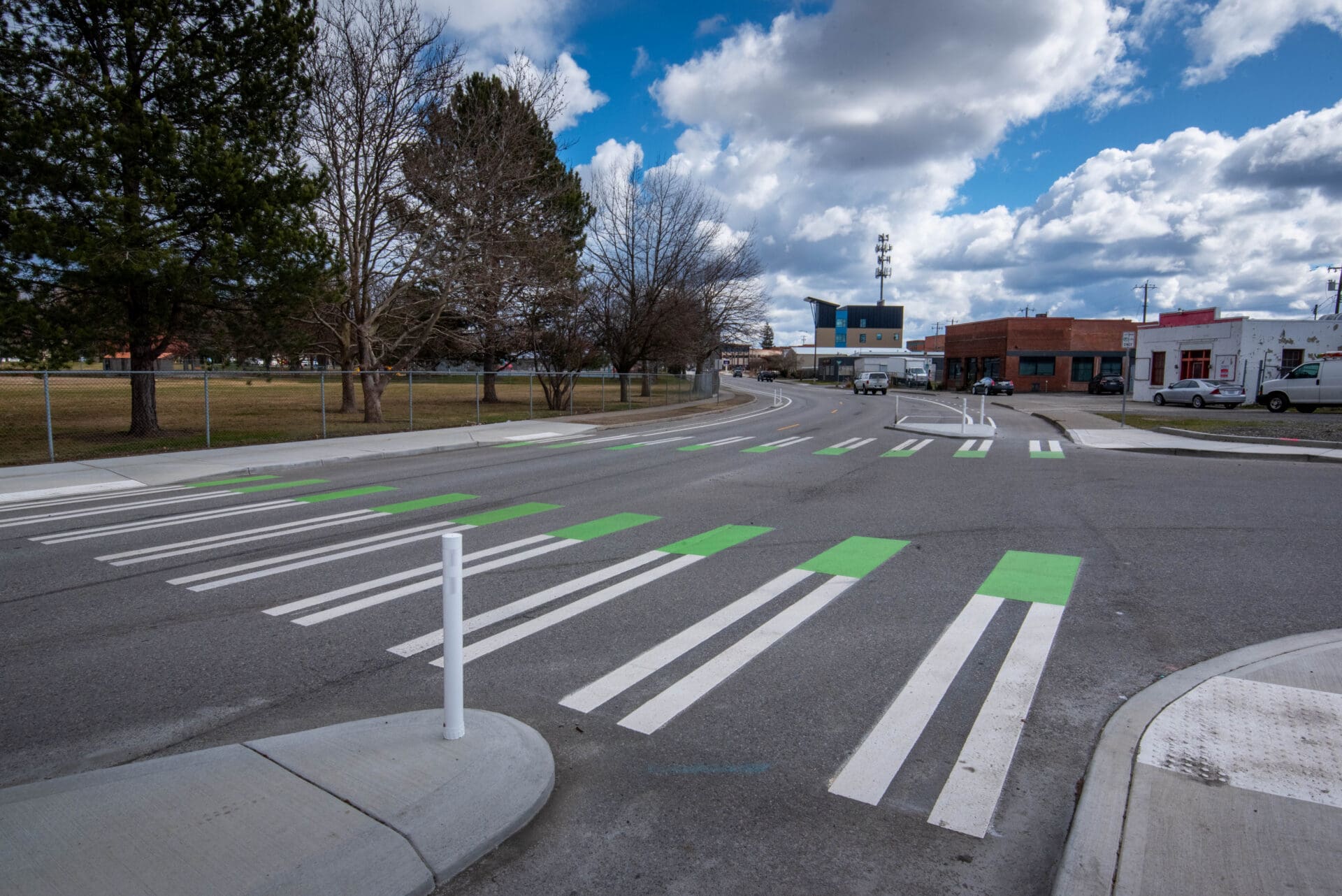
Spokane’s Urban Mobility Network intends to have 27 miles of continuous, high-quality bicycle facilities to provide an alternate way of getting around the city. At both ends of this intersection, permanent concrete bulbs help to separate the dedicated bicycle lane from car traffic. Source: Kittelson and Associates, Inc.
The city’s goal is to create a network of 27 miles of continuous bicycle facilities—but that goal is still some way off. In the meantime, the city is actively working to make progress where they can, connecting their permanent facilities using ad hoc strategies like quick-builds or restriping. Importantly, these temporary facilities allow built facilities to provide value while leaving the door open for more permanent installations down the road, once funding becomes available.
There’s a secondary tip in here as well: you’ll find that “opportunity” will strike much more often if you limit your implementations to those that work within the existing curb lane. Instead of advancing designs that would require you to reshape a roadway’s built environment, consider how the available space can be redistributed to better suit the needs of all users.
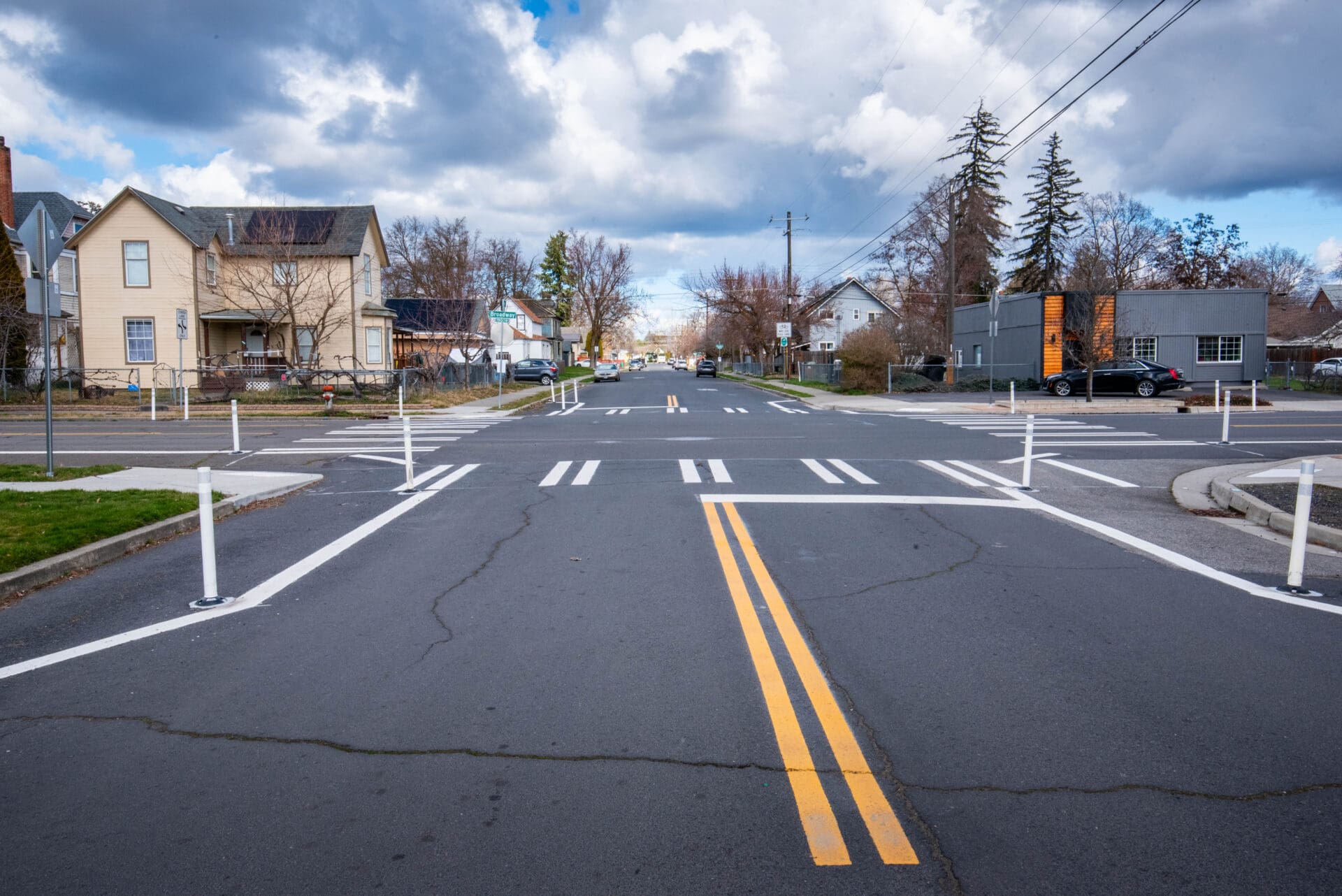
The Urban Mobility Network isn’t completed yet; in the meantime, the city is implementing low-cost quick-builds along segments of the network. In this photo, flexi posts and restriping make for temporary curb extensions. Source: Kittelson and Associates, Inc.
Focus on the lowest-cost way to make progress: relationships.
Relationships, whether with your MPO, neighboring locality, or state transportation practitioners, are low-cost assets to build in moments when unexpected funding hurdles have pressed pause on a project. These relationships are not just inherent goods in themselves; they can also lead to greater efficiency when your paused project resumes.
Consider again the City of Spokane’s Urban Mobility Network. The stretches of permanent bikeway that have already been installed in the network weren’t implemented as standalone projects; instead, they were often bundled with other roadway rehabilitation projects. This sort of savvy project bundling happens when transportation authorities develop close relationships with their jurisdictional partners.
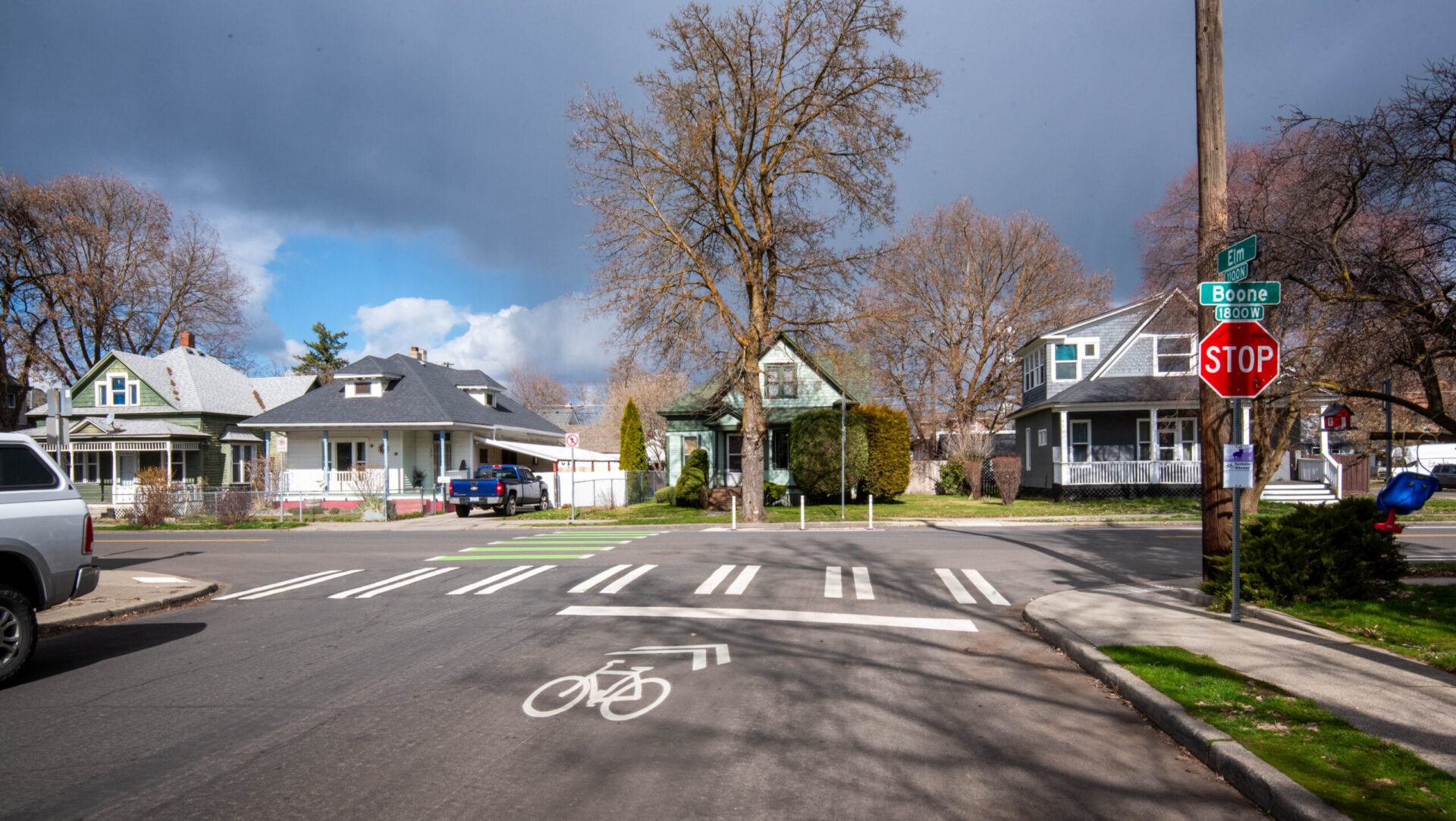
One way to make progress when resources are tight? Working within the existing curb lane. Source: Kittelson and Associates, Inc.
These relationships bring evergreen value, no matter what phase a project is in. While it pauses work on stretches of the network, the City of Spokane is intentionally collaborating with its planning partners (like neighborhoods, the local transit agency, developers, and utility companies) to better coordinate their respective needs, minimize redundant use of resources, and maximize the benefits for everyone. In this way, just one instance of a pause is actually leading to a smoother overall process once the project resumes.
Consider the project’s packaging.
Our roadway infrastructure is expected to be comprehensive—among their many functions, we want our roads to anticipate and accommodate all users regardless of mode, and act in congruity with public utilities, and facilitate timely emergency response services, and be cognizant of context and surrounding land use. The projects we implement on roadways must also be cognizant of and responsive to these various needs. As a result, a single project will likely be relevant to many different sources of funding. If one funding source dries up, you can consider the ways in which your project might fulfill the goals of a second, active funding source. This might involve adjusting the scope of your project, but it just as often won’t. Perhaps a project that initially focused on reconnecting communities harmed by past interstate development could instead emphasize the economic benefits it would provide by reconnecting two parts of a downtown.
Understanding what funding sources prioritize is always a good exercise to conduct, even when the funding source you’re eyeing for your project isn’t in jeopardy. Even legacy funding sources will shift over time depending on the current priorities of the moment. The BUILD grant program—which began life as the TIGER grant program before becoming the BUILD grant program before eventually becoming the RAISE program before being rebranded back to BUILD—shifted which criteria it prioritized just between its 2025 and 2026 Notice of Funding Opportunities (NOFOs). Whereas the 2025 NOFO prioritized “safety, environmental sustainability, mobility and community connectivity, or quality of life,” the 2026 NOFO “changes priority merit criteria to: safety, quality of life, mobility and community connectivity, and economic competitiveness”. There’s a subtle but notable shift in priorities here, and accentuating the way in which your project matches that shift is always a winning strategy.
Stay on track with state and local trends.
Although it’s true that state-level funds often follow the priorities of the federal administration (as previously stated, doing so allows states to receive matched federal funding on projects), it’s also true that there is state-level transportation funding that exists independently from the federal government. Regardless of what’s happening at the federal level, many states continue to prioritize projects that are driven by market forces and private industry, like intelligent transportation systems and connected vehicles.
We’ve recently started partnering on the Regulatory Assessment of Remote Assistance and Remote Driving project, which is funded by the Automated Vehicle Pooled Fund Study (AVPFS). The AVPFS isn’t related to any grant program—instead, it’s a collection of about eight states who are jointly funding AV research.
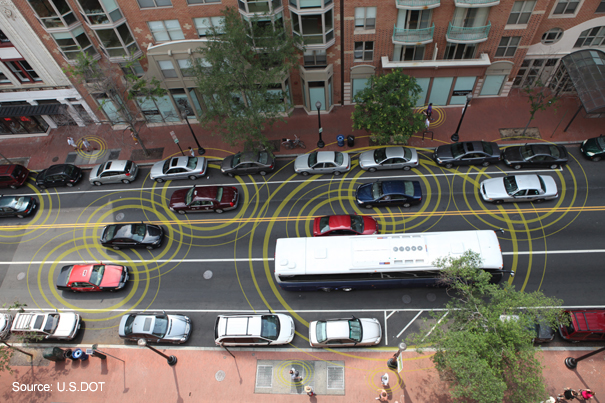
Connected vehicles have equipment that communicates with other vehicles and some infrastructure in the built environment. An evolving technology, connected vehicles have the potential to make travel safer and more convenient. Source: U.S. Department of Transportation
The AVPFS, like other pooled fund studies, provides an opportunity for states to be in control of the scope and timing of research as compared to traditional processes that involve federal sources. In these traditional processes, it can be years before a state hears back about a research need they’ve submitted, and that’s not accounting for any changes in staff makeup that may occur. Pooled fund studies also let states pool their money if they don’t have individual research budgets to cover the studies on their own. To get a better sense of the priorities of your state or local jurisdiction, reach out to your State DOT research unit, which manages the funding received from any pooled funds study. These State DOT research units can also request to join ongoing pooled funds studies, or even to start a new one.
Pauses Are Full of Possibility
The process of identifying, securing, and using federal funds for transportation projects can be overwhelming on the best of days, especially for transportation authorities that work with smaller teams or that have less experience navigating the funding landscape. When uncertainty strikes, the funding process can seem all the more impenetrable.
The good news is, regardless of the state of the funding landscape, you never have to navigate the terrain alone; we can help you through it. We understand the funding environment and watch closely how our clients are maneuvering in times of change. When uncertainty strikes your project, we can be your own personal source of calm, helping you adjust your project timeline, phase your project, or identify additional sources of funding.
Reach out if you have any questions, or if you want our thoughts on how you can work through your next funding pause.