
February 11, 2026

Across the country, major cities have increasingly been facing natural disasters, from the historically destructive Los Angeles wildfires in January of 2025 to the back-to-back cyclones in Florida in 2024. In emergencies like these, transportation infrastructure comes under massive strain to get people out of harm’s way. This raises the question: how can we prepare systems designed for everyday needs to withstand the extreme?
Already central to the everyday needs of communities, public transit can become even more critical during disasters. Although it is still an emerging strategy, transit can be pivotal in evacuations, to transport emergency workers to and from essential services, and to bring people back from evacuation centers after the emergency has ended. People who don’t own cars are often left stranded without public transit to evacuate them, and those who do have car access may become dependent on transit if their vehicles are damaged. Even if one has a working car, highways quickly become choked with traffic, making it difficult to drive a car to safety.
Despite its necessity, like all other infrastructure, transit is put under strain during natural disasters. Bus and train routes may be flooded, snowed in, or suffer fire damage; the vehicles themselves may be unsafe to operate; electric fleets might be rendered unusable if they lose their power source; and bus drivers may be unable to report to work. That’s why having a plan in place to keep transit up and running safely and to recover transit as soon as possible after a disaster is vital. We’re seeing more and more agencies invest in emergency preparations, and it’s these efforts that are making a difference in keeping people safer, making infrastructure stronger, and helping a region’s economy bounce back faster.
Making a Transit Resilience Plan
By nature, emergencies are unpredictable. Predictive technologies can help us track the travel paths of hurricanes and air quality monitors keep us posted on the spread of wildfire smoke, from a standpoint of months or years out, we can’t know when the next disaster will hit. This makes having a written plan in place both essential and tricky. But creating a plan for emergencies can be an intensive and unfamiliar lift, especially for smaller transit agencies.
To ease the burden, the U.S. Department of Transportation Volpe Center published the Transit Resilience Guidebook to guide agencies in creating and implementing emergency preparedness and management strategies. The guidebook breaks down resilience planning into six steps:
1) Assess: Identify vulnerabilities and climate risks.
2) Plan: Outline opportunities to plan for emergency preparedness and recovery.
3) Design and Construct: Develop and adapt projects with hazards in mind.
4) Manage: Optimize asset management.
5) Maintain: Integrate resilience into operations and maintenance.
6) Monitor: Track progress and evaluate impacts.
The guidebook provides various kinds of indicators to help agencies understand how they may be at risk and what areas are most important to address. These include exposure indicators to determine how prone the region is to climate disasters, sensitivity indicators to determine vulnerabilities in transit infrastructure and resources, and adaptive capacity indicators to determine how ready an agency is to respond to a disaster.
Having a resilience plan established is a vital step to successful emergency management, but it shouldn’t be the only step. Practicing emergency response roles in tabletop exercises can:
- Generate ideas and strategies to be included in resilience plans
- Put existing strategies to a practical test to find areas for improvement
- Help staff gain confidence and familiarity with their responsibilities in an emergency
Summit County in central Colorado conducted one such tabletop exercise as part of the comprehensive evacuation planning they are conducting with the help of Kittelson. Doing so helped County staff and stakeholders take inventory of what resources they had, like the state of their vehicle fleets; what resources could be made available, like if neighboring counties have facilities that could be used for evacuation centers; and decide at what point in a disaster they’ll need to pull in other agencies for help. Summit County has only dealt with small-scale evacuations in the past, so its choice to take on evacuation planning underscores the growing importance of preparing for the “what ifs.”
By taking advantage of these two planning measures, agencies can take stock of their resources—both material and personnel-wise—before a disaster hits and set up actions to take during a disaster. This limits the making of critical decisions under pressure, time constraints, and limited lines of communication, which manages disaster response in the moment and improves resilience after the fact. Across regions and types of disasters, transit resilience plans often address three types of strategies that work together: preventing damage, streamlining evacuations, and optimizing communication. Let’s zoom in on the aspects and importance of each.
Taking Stock and Preventing Damage
A large part of preventing damage to transit during emergencies involves understanding which resources are most vulnerable and strengthening them, replacing them, or establishing backups. For example, bus depots may sit on low-lying ground that is at risk for flooding, which can damage electric chargers. In the long term, relocating these facilities to higher ground is most effective, but a more quickly achievable solution is to use hanging pantograph chargers. A Science Direct study explains how these chargers connect to frames over the buses (as opposed to chargers that connect side-by-side to a vertical structure), which both allows for more buses to charge simultaneously and reduces the risk of water damage to charging infrastructure.
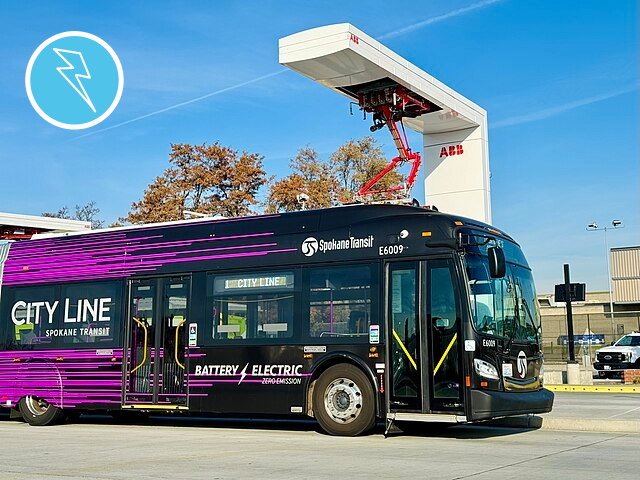
An electric bus in Spokane gets its batteries filled up by a pantograph charger—a space-efficient and minimal-risk way to sustain electric infrastructure. Source: Wikimedia Commons
In the case that the power grid goes out, backup generators and diesel chargers are useful resources to have on hand. Innovative solutions are also emerging, like Martha’s Vineyard’s use of on-route battery storage for partial backups during shorter power outages and Montgomery County’s independent microgrid that charges electric buses using energy from solar panels at the bus depot.
But power isn’t the only preparation need at play: acquiring specialized resources and conducting staff training are both crucial to do in advance of a disaster. As explained in a case study from the Transit Resilience Guidebook, after floods in 2015 and 2016, Houston Metro bought highwater vehicles that they used to drive through flooded areas. But vehicle acquisition is only half the battle; drivers must be trained on how to operate these specialized vehicles. Moreover, identifying and training staff to manually direct traffic at busy intersections can streamline efficient evacuations, as traffic signals are put out of commission by power outages. Having people manually control traffic, in turn, helps bus drivers navigate altered routes and keeps car drivers away from dangerous roads.
Beyond this, emergency management can be integrated into all aspects of urban planning. Many initiatives to make roads safer, like adding speed humps, roundabouts, and lane narrowing, can have adverse impacts on emergency response if not planned with appropriate measures. Looping in emergency personnel early in the processes helps roads stay efficient for emergency response use. In fact, California legislature now requires any General Plan Safety Element to analyze evacuation routes.
Here’s an example of how to balance these needs: roundabouts are proven to slow speeds and reduce crashes, but they can be difficult to navigate in large vehicles, like ambulances and fire trucks. Building roundabouts with a softly sloping curb and drivable raised area around the center island allows these large vehicles to drive over the edge of the island, giving them a quicker and more direct path through the intersection. With solutions like these, we don’t have to choose between everyday safety and safety in emergencies.
Transit Practices for Smooth and Safe Evacuations
Evacuations are a big lift—massive numbers of panicked people need to be relocated while resources and lines of communication are strained. Transit is pivotal since it can move large groups quickly and most people are already familiar with their local transit agency. When using transit for evacuations, two main strategies emerge: “all the way out” and “hub and spoke.” Transit vehicles can carry people all the way out of the impacted area to a safe center, or they can gather people in a central location where another shuttle will take them all the way out to safe evacuation centers staged in places like school gyms, places of worship, and town halls. Schools and community centers offer prime pickup spots for evacuation shuttles, since many bus routes already frequent these locations and they represent places where people congregate, in a crisis and otherwise. Cities with strained transit resources often opt for the hub-and-spoke method because the many shorter trips involve keeping vehicles local most of the time, aiding in adaptive response and thorough pickup coverage.
Whichever strategy guides evacuation, it’s important that the routes chosen are safe. In advance of or during emergencies, alternate emergency routes and staging areas should be established that are likely to avoid impacted areas. For example, as the Transit Resilience Guidebook summarizes, the Southeastern Pennsylvania Transportation Authority (SEPTA) redirects routes and stages vehicles on higher ground to avoid flood damage—and they haven’t experienced any storm-related vehicle damage since Hurricane Sandy. Finding new spaces to stage vehicles can require some creative thinking, though. Houston Metro used bus priority lanes to stage buses in advance of Hurricane Harvey, with queues of vehicles extending for over a mile.
As agencies adapt their standard routes for streamlined evacuation and safer travel, they may also need to add services that plan for mobility-impaired populations in evacuation routes. Especially on routes with fewer stops, pickup locations can become overcrowded in emergencies. Setting aside priority bus boarding areas for seniors and people with disabilities can help evacuation to be more orderly and can keep people from getting left behind. Making designated shuttle trips to senior living centers to pick up for evacuation helps bridge the gap for people who may not be able to get to a regular transit stop. Considering accessibility, paratransit vehicles need reliable fuel sources. Gas stations can run out of gas during evacuations, so storing gas in an emergency facility or transit depot ahead of emergencies can be essential.
Considering unhoused populations during evacuations is also essential. As discussed in an episode of the podcast “Transit Unplugged,” areas where unhoused people generally congregate should be identified in an emergency plan, and shuttles should make trips to move the people there to evacuation centers, especially as these populations are likely to be the most transit dependent. Making a general evacuation plan that services key stops throughout the city is a backbone of emergency management—but to be effective for everyone, add-on routes like these can be needed to protect vulnerable populations.
Agencies may rely on transit from other agencies to support disaster management efforts. This doesn’t just include getting people out, it also means getting essential workers—like bus drivers—to and from a safe evacuation center and their work area. Other agencies in the region can provide staff when usual drivers and maintenance crews are unable to report, as well as vehicles when fleets are damaged. Mobilizing inter-region transit services can also be hugely helpful in transporting people long distances to safe evacuation centers, as their routes already service multiple cities. Local resources, too, can come in handy: time and again, school buses have been used for evacuations, aided by advance coordination with local school districts.
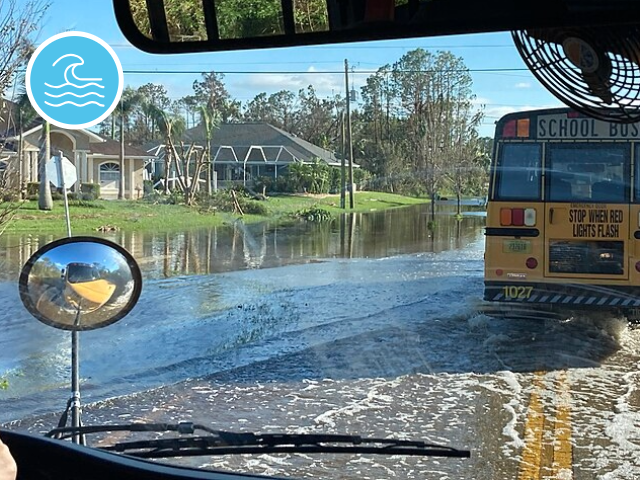
School buses transport residents across flooded roads in the aftermath of Hurricane Ian. Source: Wikimedia Commons
Communication in a Crisis
In order for all these preparation and evacuation techniques to be effective, the public must have access to updated information and instructions. But when power may be out, the usual methods of sending service updates to riders and staff—like social media posts and push notifications—aren’t reliable. That’s why having a communication plan in place is vital. Often in disasters, it’s time to go old school. Designating representatives from transit agencies, City and County governments, police departments, sheriff’s offices, schools, major employment centers, healthcare, and other key organization representatives to report to an emergency operations center consolidates in-person communication and keeps people on the same page. The message these groups bring to the public is then more unified and effective, and by targeting specific groups, may reach more people. In less populated areas, it may even be feasible for police or other public agency staff to make rounds to knock on doors and alert residents of evacuation pickup locations.
It’s not just the communication between transit agencies and the public that has to be creatively upheld; interagency communication is integral to achieving an organized, well-resourced, and efficient emergency response. Coordinating with the county sheriff’s office, the police department, the emergency operations management team, school district officials, and transit agencies in neighboring urban areas can all streamline efforts—so long as all these groups communicate about delegation so as not to redundantly tackle the same issues. To ensure this doesn’t happen, a transit agency can communicate with other agencies before disaster hits to take inventory of what other resources may be available and to plan how to utilize them, so that when they need to call on help, it can come swiftly and in targeted ways.
Getting Back on Track
All this planning helps cities endure disasters more safely—but what about after the worst is over? The resilience of transit can determine the resilience of a region’s population and economy. Not only is transit helpful for bringing evacuees back into the city once it is safe, but it can be used to help people access healthcare, food, childcare, and employment. Preparing transit to take the least amount of damage pays off in the rehabilitation stage, but adaptive measures are often still needed. SEPTA reconstructed portions of their trains’ interlocking system to restore some areas of service rather than waiting for the entire system to be fixed, which would have left transit inoperative for longer. And again, coordination with other agencies to rely on their resources can help bolster a weakened transit system as it gets back on its wheels.
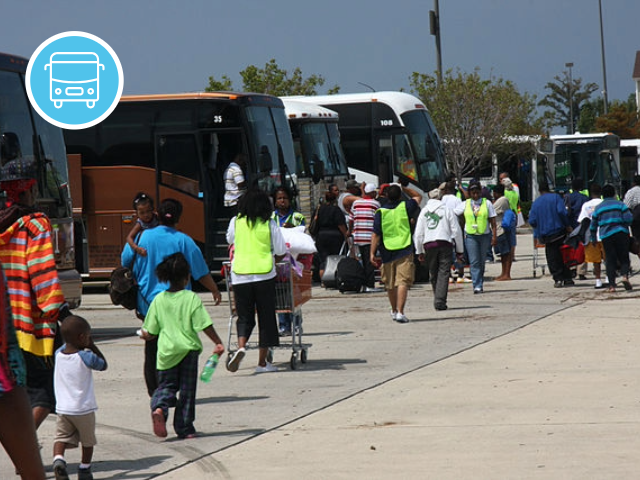
Hurricane Katrina evacuees board buses to return to New Orleans after the storm has ended. Source: Wikimedia Commons
Transit recovery is often considered with the goal of “getting things back to normal,” but after catastrophic events make their way through a region, the fabric of cities and their populations are left changed. Disasters can result in long-term displacement and economic stagnation, shifting the demographic makeup of neighborhoods and the workforce and affecting where transit will be needed and used. After Hurricane Katrina, a National Academies publication explains, New Orleans experienced massive job loss. Many low-wage workers—the primary users of transit—left the city and never returned, and in the following years, population growth in the city was largely defined by influxes of wealthier residents. Perhaps due to this change in demand, New Orleans has fewer buses and routes today than in 2005, and ridership is under a third of pre-Katrina levels.
While agencies cannot predict the effects that disasters will have on their cities, it is critical that recovery plans consider possibilities beyond returning to the prior status quo. Anticipating which areas may be less equipped to recover after the disaster and prioritizing route changes that service these areas more and connect them to employment centers can help communities bounce back and prevent displacement.
Emergencies aren’t something anyone wants to think about, but we all need to. Proactive measures like the ones suggested in transit resilience plans can keep our cities moving forward even in the face of unexpected hurdles. With thorough preparation, coordination, and communication, our transit—and as a result, us—can get through anything.