
July 16, 2026

At the end of May, the House of Representatives’ Committee on Transportation and Infrastructure released an approved draft of the country’s next transportation reauthorization bill, currently titled the Building Unrivaled Infrastructure and Long-Term Development (BUILD) for America’s 250th Act (or more succinctly the BUILD America 250 Act). If passed into law, this bill will supplant the expiring Infrastructure Investment and Jobs Act (IIJA) as the country’s guiding vision for how transportation monies are dispersed. But until that happens, it’s just a draft.
This is the latest enactment of the ritual known as transportation reauthorization. This ritual emerged in its modern form in the 1950s, when Congress passed federal legislation declaring that revenues from federal taxes would fund the country’s interstates and highways. Federal tax revenues fund many goods and services in the country, but unlike other federal discretionary spending programs that need to be renewed by Congress every year, the legislation funding the country’s transportation infrastructure lasts for six years. The relatively long lifespan of transportation funding laws like IIJA is the federal government’s method for increasing consistency and follow-through in transportation infrastructure planning and implementations, which often take years to gestate and construct in the built environment.
Today, we’re breaking down the process of transportation reauthorization to better understand how the law at the top of the funding ladder comes into being. And while draft language of the BUILD America 250 act has understandably piqued the curiosity of many, we’ll discuss why it’s too early to take it as gospel, and what local transportation agencies can do while they’re waiting for the final law to pass.
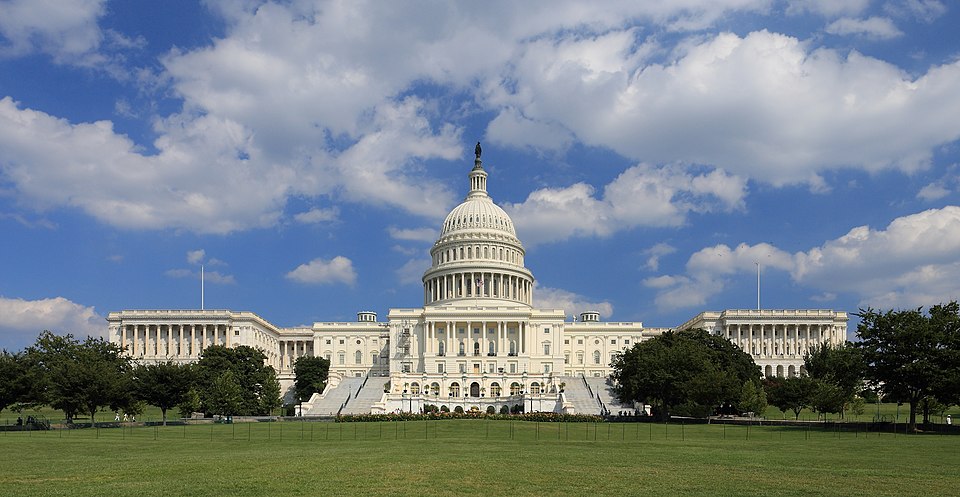
Where the law-making magic happens: the U.S. Capitol building. Source: Wikimedia Commons.
The Transportation Reauthorization Process: Or, Kittelson Does Schoolhouse Rock!
Many of us learned how a bill becomes a law from a crooning scroll of parchment paper. For those of us who didn’t grow up with Schoolhouse Rock!, or who can’t remember every verse of the song, here’s a refresher.
The process of imbuing a federal bill with the power of federal law is lengthy and polyphonic—plenty of people have a say on what a bill contains before it comes time to vote on it. A bill can be introduced in either chamber of Congress (the House or the Senate) by one of that chamber’s sitting lawmakers. The bill is then matched, typically by subject matter, to one of that chamber’s committees for a first round of review.
The bill of the BUILD America 250 Act was introduced to the House by the same committee that reviewed it: the House Transportation and Infrastructure Committee, which, as the name suggests, is tasked with reviewing funding for transportation and infrastructure needs based on the priorities of the current administration. The committee plays an oversight role over the U.S. Department of Transportation (USDOT), meaning this committee plays an upfront role in shaping the laws that guide the decisions of the institution that disburses transportation funding; on the backend, it also means this committee monitors USDOT to ensure it has implemented relevant laws as they were intended.
During committee review, the lawmakers who sit on the assigned committee discuss, propose edits, and mark up the draft language. Only once the bill has been revised to their satisfaction does the committee give its blessing for the draft bill to be reviewed by the entirety of the chamber in which it was introduced. The entire chamber then undergoes the same process as the committee: they review, comment, propose changes, and eventually approve it or do not.
Once the bill’s originating chamber approves the bill, they pass the bill to the other chamber, and it undergoes this review process once again. Only when—if—both chambers approve of the bill does the legislation then travel to the president’s desk, where the president either signs it into law or vetoes it. If the House and Senate pass different versions of a bill (like a transportation reauthorization bill), they must reconcile those differences and approve identical text before the bill is sent to the president. And all of that must happen within the same Congress! If a bill fails to pass both chambers before the end of a two-year Congress, it expires and must be reintroduced in the next Congress, starting the legislative process over again.
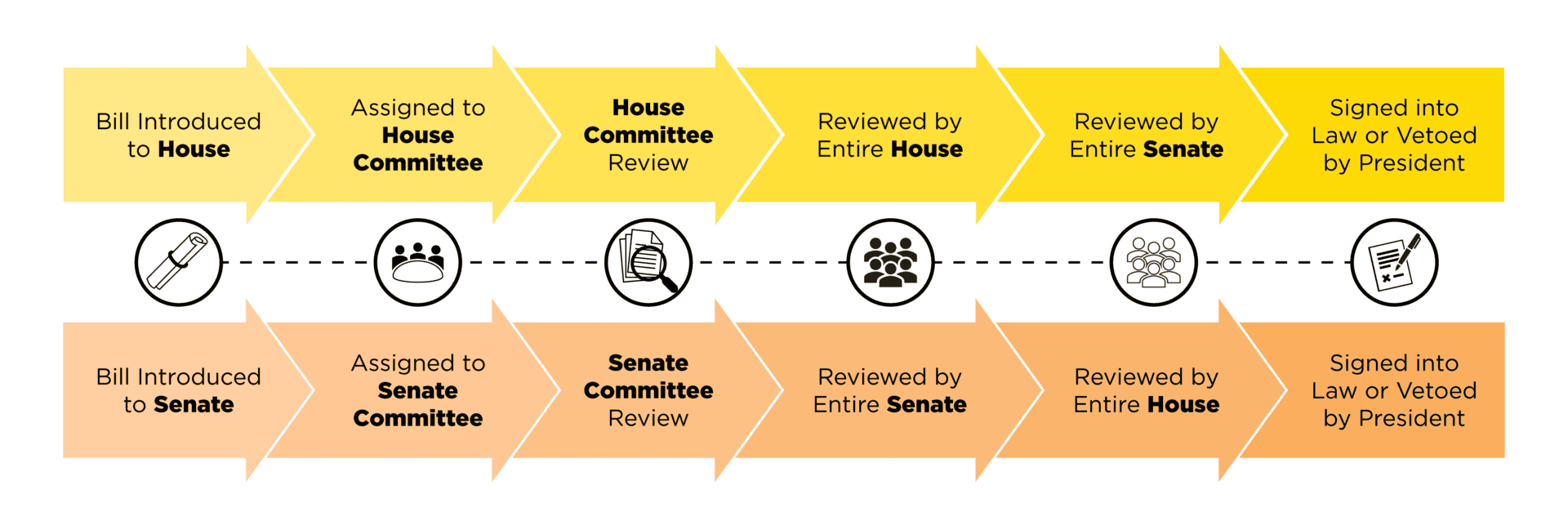
The process of imbuing a federal bill with the power of federal law is lengthy and polyphonic—plenty of people have a say on what a bill contains before it comes time to vote on it. Source: Kittelson
If the process sounds slow, unwieldy, and subject to changing political winds, that’s because it is. Or rather, the process is slow, unwieldy, and subject to changing political winds for bills that make it all the way. For most bills, the process is much shorter, because most bills never make it past the first round of committee review. Of more than 17,000 bills introduced in the current Congress, only 102 have become law. When a transportation reauthorization bill dies in Congress (or is delayed), Congress passes short-term funding extensions until a version of the reauthorization makes it all the way. (As this primer by Transportation for America points out, these extensions have played a central role in the reauthorization process for decades, and likely will again this cycle.)
Finally, keep in mind that this process (or a variation of it) occurs in state-level governments for state-level laws, as well. State congresses are entitled to set laws dictating what is or is not permissible within their individual borders so long as those laws don’t conflict with existing federal law or with a Constitutional right. In many cases where the federal government has declined to set a nationwide precedent, state laws step in to regulate. (Consider how, in the absence of a federal law setting an interstate speed limit, states determine their own.) And like the federal government, states have their own departments of transportation that interact reflexively with state and federal law to determine what’s meaningful, wanted, and needed on state-owned roadways.

Congressional committees have been around as long as Congress itself. Here, an illustration shows activist Victoria Woodhull speaking before a congressional committee in 1871 regarding proposed legislation on women’s suffrage. While several states passed laws allowing women to vote in the nineteenth century, it was constitutional amendment—not federal legislation—that eventually made it available to all women in America in 1920. Source: Wikimedia Commons
Where BUILD America 250 Is Right Now
Right now, the BUILD America 250 Act is closer to the beginning of the labyrinthine process that is transportation reauthorization than its end. While the latest draft has been vetted and approved by its originating committee in the House—meaning it’s survived the step that fells most legislation—it has yet to be reviewed by the entire House of Representatives, which will likely propose several more changes before potentially approving it. After that, the reauthorization bill will have to make it through the Senate. In the meantime, the Senate is working on their own version of a transportation reauthorization bill that they might advance to the House.
Long story short: we still have a long way to go before the next transportation reauthorization bill is signed into law, and it’s overwhelmingly unlikely that, when it finally lands on the president’s desk, it will be the same version that was released by the House in May.

Whatever it ends up looking like, this cycle’s transportation bill has several steps remaining before it reaches the oval office. Source: Kevin Wood, Pexels
So while there’s a temptation to draw conclusions from the current draft language regarding what kinds of transportation projects the federal government will prioritize in its forthcoming funding cycle, we are still some time away from reauthorization’s completion. From the time of this article’s writing, it could be two years before the bill becomes law, and another year or more beyond that before any of the bill’s funding actually reaches a local transportation agency’s bank account.
Still, it’s understandable why local transportation agencies are paying close attention to the language of this BUILD America 250 draft, as certain to change as it is: draft bills are breadcrumbs that can lead us to a greater understanding of what issues and priorities will shape how money eventually trickles down from the federal government to local communities when a bill finally does pass. The draft of BUILD proposes to continue funding several safety-focused programs introduced under IIJA, including Safe Streets for All. While we don’t yet know how much money will be distributed (or when it will be available), this is a great sign that we should expect to see continued support for safety-driven projects.
So what should we do while we wait? This question isn’t new to us: in March, we wrote about what municipalities can do to make the most of funding “pauses”—periods in which the transportation funding landscape is in flux, as is the case with the ongoing transportation reauthorization process. Now, as in March, what’s most important for agencies and practitioners to do is not to try to predict the finalized version of the reauthorized bill, but to set themselves up to make the most of it when it does.
Three(ish) Things You Can Do as the Transportation Reauthorization Process Continues
1. Tap Industry Professional Organizations for Updates on Reauthorization Bills
Instead of trying to guess what’s going to happen in, say, 2029 based on unfinalized language drafted in 2026, we recommend keeping abreast of updates to the transportation reauthorization legislation process. You don’t need to do this on your own. Instead, consider engaging with your local chapters of professional organizations in the industry for help. These organizations not only track the development of new/forthcoming funding, but they also advocate for certain funding to come out of these legislative bodies. Some professional organizations we follow include:
- American Council of Engineering Companies (ACEC)
- American Public Transportation Association (APTA)
- Association of Pedestrian and Bicycle Professionals (APBP)
- Institute of Transportation Engineers (ITE)
- American Association State Highway Transportation Officials (AASHTO)
- American Planning Association (APA)
- Advancing Women in Transportation (WTS)
- American Society of Civil Engineers (ASCE)
- American Society of Landscape Architects (ASLA)
- Association for Metropolitan Planning Organizations (AMPO)
- National Association City Transportation Officials (NACTO)
These professional organizations represent a wide range of backgrounds, experiences, skill areas, and interests that together make up the transportation industry. Remember that these groups exist to knowledge-share: they each convene a body of professionals, often organized around a different interest area in the practice. You don’t need to rely on just one group’s interpretation of forthcoming developments to the BUILD act; comparing and contrasting several different interest group’s impressions will give you the fullest picture of how the bill is developing and changing.
2. Stop Guessing Upward: Start Looking Around You
Most critically, we think local agencies should use their time in this funding limbo not to anticipate future grant programs but to identify their community’s particular needs. This might involve authoring a safety action plan or local transportation plan to identify systemic weaknesses in your roadway network.
If you already have a guiding document, focus on identifying sustainable funding for the recommended implementations, operations, and maintenance. If your safety action plan recommends quick-build traffic-calming treatments, for example, consider both what the initial implementation would cost as well as how much ongoing maintenance will cost.
This is good housekeeping generally—not just during the season of transportation reauthorization. No matter how long the next transportation reauthorization bill takes to pass, proactive planning will get your ready to apply for any eligible funding—whether federal, state, private, or other—that may come available in the meantime.
Knowing your particular community’s needs and opportunities is an important step to navigating any funding pause—or for getting ready for the next transportation bill. Take stock of what implementations are ongoing in your community, and which implementations you’d like to see change your roads in the years to come. Source: Tom Shamberger, Pexels
3. Search for Funding That Is Sustainable to You
It’s true that the current draft gives some insight into the next cycle of transportation funding’s priorities: but it’s just too early to know with certainty what funding you’ll be allocated.
In the meantime, for your projects that are absolutely critical, it’s a safer bet to start looking for sustainable local funding sources. This might look like public-private partnerships, or reframing your project so that it aligns with the work of a local transportation tax (and can thus make use of its revenue).
Bonus: Lean In to Other “Pause” Best Practices
We gave some additional tips during our last funding check-in. You can revisit that article to read about each one in detail, or read a quick summary of them below:
- Anticipate and prepare for funding pauses by having a backlog. Pauses are a part of project funding, not an exception to it. When one project encounters a pause, turn to your backlog of projects – there might be a different one that’s more to the taste of the funding that is currently available.
- Start where and when opportunity strikes. Connectivity is critical in many projects, especially those based around safety for vulnerable users, like bicycle or sidewalk networks. But don’t let the prospect of incomplete amenities keep you from implementing anything at all. You can always patch together a network over time.
- Focus on building relationships. Networking is a low-cost form of progress you can make during a funding pause. You never know how a relationship formed today might pay off down the road.
- Consider the project’s packaging. If one funding source for your project dries up, you can consider the ways in which your project might fulfill the goals of a second, active funding source.
- Stay on track with state and local trends.
Reauthorization Is a Marathon—It’s Helpful to Have a Coach
Navigating the transportation reauthorization process is a marathon, not a sprint. But you don’t have to run it alone. Here at Kittelson, we have experts who have dedicated their careers to understanding the federal- and state-level funding processes, and who can give you pointers on how to proceed in times of funding uncertainty. Want to talk more? Reach out!