
July 16, 2026

As AI continues to transform the way we communicate, design, and work, transportation professionals are figuring out how it affects the most technical aspect of our work: final design. Our firm is approaching AI with curiosity and intention, looking for ways to integrate it into workflows while grounding any experimentation in human judgment, experience, and expertise. And although we’ve seen AI’s potential to support some aspects of our work, final design has remained an area rather immune to the skills AI has to offer.
Final design is the process of creating the layout for transportation infrastructure to be constructed, whether that’s a single curb ramp or an entire roundabout. It typically comes after most other stages of a project process. Scoping, proposing alternatives, collecting public feedback, and refining a plan all need to occur in order to land on the exact idea that will be laid out by final designers. These layouts can involve everything from a concept sketched by hand or in software all the way to full construction plans with signing and pavement markings. Because of the inherently spatial and visual nature of final design, it’s tricky to apply the large language models (LLMs) that are used to recognize patterns and generate content.
We dug into where AI shows up in final design, and what makes applying AI here so different. Our designers shared with us what they see as AI’s inherent limitations in design, its opportunities to level things up, and important questions to keep asking as this technology continues to transform the industry.
The Debacle with Design
Final design often involves two main stages: first, creating detailed models in AutoCAD Civil3D or Bentley OpenRoads Designer, and second, creating the printed contract plan set that acts as the final deliverable. Plan sets are essentially the blueprint for construction and represent a cleaner version of a model.

A roundabout model in AutoCAD shows the precise calculations that define every inch of a design. Image source: Fred Wismer, Kittelson and Associates, Inc.
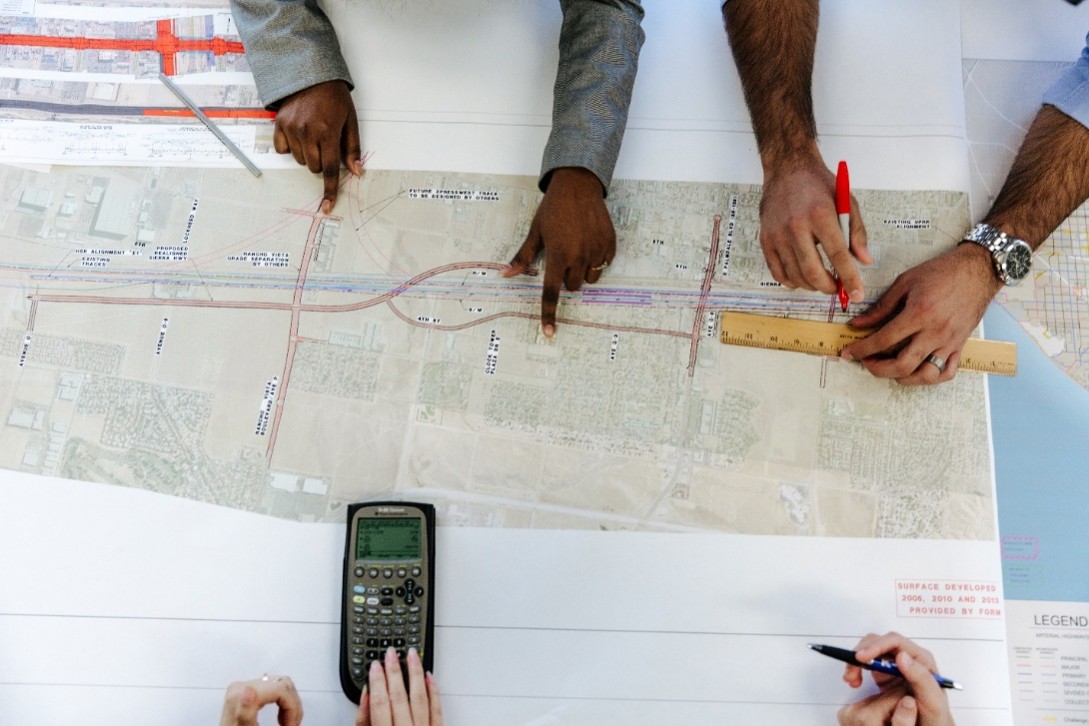
Final design can also involve drawing by hand to visualize how a facility fits into an existing site. Image source: Kittelson & Associates, Inc.
AI tools have sought to generate models (that first stage of the final design process), but they’re not yet able to do so with implementable accuracy. One of the big reasons AI models fall short is that final design involves weighing countless factors and tradeoffs, from the higher speeds that flatter curves might induce to the impacts of traffic noise on nearby residents. In final design, it’s often impossible to nail down one definition that can apply in all cases. AI, on the other hand, tends to rely on precise, repeatable definitions to generate useful outputs.
Regional considerations can also make it hard to train an AI designer. An intersection in one city might be subject to different weather conditions, land-use restrictions, and standards for building materials than another. Such context ultimately affects the features and geometry of the design. For example, there might be four different kinds of curbs used in just one county, and an AI tool could pull the wrong curb type for a given project.
It’s pretty easy to get an answer from AI, but it’s often hard to tell if that answer is correct, especially when correctness relies on locally specific standards that aren’t apparent without further research. Commonly used review methods like spot-checking aren’t always sufficient to catch these mistakes. Even if AI could get 98% of a design correct, the erroneous remaining 2%—now difficult to spot due to the otherwise accurate output— could have serious implications. An error might seem minor when it comes to curb variations, but the same process could have life-changing impacts on, say, an intersection misalignment that ends up increasing crash risk.
The overuse of AI also represents a potential threat to good final designs. Engineers often hone their reviewer chops through the practice of working through design challenges. If AI starts to do too much of this work, it might undermine the very system that keeps engineers at the top of their game. Human reviewers should still be able to understand how AI came to the result it did, but this becomes much harder when the reviewer no longer regularly does that work themselves.
Further compounding the AI landscape is the uncertain future of the pricing of these tools. Over the past few years, as AI tools have proliferated, we’ve seen access change from free-to-use to subscription-based to use-based. And as AI tool providers face a changing funding landscape, how prices will look to consumers in the future remains uncertain. If transportation agencies, which often have limited funding to begin with, rely on AI tools that become unaffordable, they’d need to procure new resources and retrain staff, both of which could delay the important work of final design.
Where AI Can Add Value
It’s not all doom and gloom! Although AI might not be ready to model designs, it has a lot of potential for improving the context that informs final design. Surveying site conditions in the field is a central precursor to design, whether it’s to measure the slope of the ground or to count how many drains are on a road. Engineers who practice final design are essentially crafting computer-based models of a road; to do so, they need to understand exactly what that road looks like. However, taking this data by hand is time intensive and can be infeasible on large scales.
This is where AI has the potential to make a big impact. Vehicles equipped with Light Detection and Ranging technology (LiDAR) complement the images cameras give us with depth and distance. By rapidly emitting laser pulses (think over a million per second) and measuring how long they take to return, LiDAR creates a 3D map. LiDAR is often used to inform decision-making for automated vehicles, but it can also capture highly accurate representations of survey locations.

LIDAR can capture a highly detailed map of a road, pinpointing its exact topography—information that has potential to speed up design renderings. Source: Adobe Stock
Driving a vehicle equipped with this technology can collect footage that might have taken humans days in a just few hours. Then, AI software can categorize all this footage into inventories—effectively filling a database of all the street signs, signalized intersections, crosswalks, and more. This opens the door for jurisdiction-wide survey data that can be regularly updated and shared.
When city and county transportation agencies have access to local data on such a large scale, they can better spot infrastructure gaps, standardize design and signing practices, and select transportation projects that fit into the existing system. We’d love to see AI used with predictive analytics to track and predict how a piece of infrastructure may degenerate over time to support more proactive maintenance plans.
There are some drawbacks, however. Even with LiDAR, survey vehicles are still passing on a road from a single angle. Unlike when a person might walk through an area, stopping to observe an object from different vantage points, a vehicle might entirely miss a sign that is obscured by, say, an overgrown tree. And, while AI tools can be effective at identifying and categorizing items that follow typical standards—like a No-Turn-on-Red sign—it can miss things that show up in many different forms, like bike lanes.
But just because AI hasn’t gotten there yet doesn’t mean it won’t. This kind of inventorying relies on learned models, which are constantly growing as they are trained on more and more road data. And as engineers work to create more minute definitions that categorize some of this gray area infrastructure, AI could become far better at generating reliable inventories. Such growth could help expedite the planning work of finding the right facility for the right place, which would ultimately get project concepts ready to move into their ultimate form—final design—sooner.
Integrating AI from the Backend
We’re also excited about AI’s potential to augment highly customizable design software. CAD can be significantly modified by users, who can do things like program new commands and integrate tool shortcuts. Our CAD experts have worked to customize the software to be more efficient for the kind of tasks Kittelson focuses on. They test improvements on copies of CAD long before syncing it to the versions used for project work so that experimentation and refinement occur in a low-stakes environment.
The option to build flexible, assistive functions has been possible in the software for years; now, AI poses the opportunity to do more with them. CAD experts at Kittelson are experimenting with how LLMs can help create scripts that code new shortcuts into the backend.
One place where AI could someday go further than helping with backend scripts is annotation. When transportation engineers design road layouts, they annotate essentially every aspect of the design—noting the measurements, geographic coordinates of objects to be constructed and/or installed underground, and the location of features like streetlight poles and traffic signs. AI could be trained on the specifics of final design components—rather than the steps to create an entire design—theoretically allowing it to generate annotations. This task could likely play right to its strengths: identifying and applying exact answers, rather than making nuanced, subjective decisions.
As AI capabilities continue to develop, customization in CAD is a great way to experiment with what AI can do, but it’s also an opportunity to test ways to pair AI with critical human review. As our engineers experiment with what AI-generated annotation could look like, they are also testing how to build safeguards into CAD that alert users that AI needs a human to complete its work. These collaborative approaches have allowed us to explore more experimental AI tools—all while keeping the engineer aware and in the loop about their limitations.

Kittelson’s CAD team used an LLM to craft shortcut commands that they integrated into the firm’s customized CAD software. Image source: Fred Wismer, Kittelson and Associates, Inc.
Open Questions Ahead
Although AI isn’t quite ready to play a primetime role in final design, it does have potential to support context-sensitive design through field data collection and to streamline the more repetitive parts of the design process, like annotation.
But if AI tools do progress to the point where they can pop out a roundabout design, our industry will have to be ready to answer new questions of liability. When an engineer stamps a design, they vouch for the safety, constructability, and effectiveness of that piece of infrastructure. How would the meaning of an engineer’s stamp change if it was being used to certify designs created by AI? Is stamping an AI-generated design the same as stamping one created by a lower-level engineer? Regardless of source, does good review makes something stamp-worthy? If so, how do we standardize “good review”? While we’re grateful we don’t have to answer these just yet, these are the questions we’re thinking about as we explore the possibilities AI has to offer final design.
Right now, final design review involves many iterations of checking plan sets for compliance with local and national standards and engineering best practices, as well as performing many of the calculations that are initially done to create the draft.
As AI use proliferates in our industry, engineers could find themselves less familiar with such standards, and the expectations of what “thorough” really means may vary widely across and even within agencies.
Looking ahead, it’s clear to us that our industry will need shared understandings about humans’ role in partnering with AI so that we can continue to provide consistent—and safe—designs. Practitioners will also need to consider the future of the profession. For junior engineers to become senior engineers, they need to learn to perform these analyses and calculations. Today this process occurs naturally, since it’s part of drafting preliminary designs. But if AI begins to handle these initial steps, newer engineers may face a big learning gap. If AI-generated final designs become a reality, firms and agencies will need to get creative with alternative educative processes to keep engineers advancing in the profession.
For our part, Kittelson engineers are moving forward with caution as they test new tools in controlled environments, learning what’s possible while maintaining the keen judgment that comes with years of experience and many reps at the drafting table or screen. We’re asking those tough questions and openly communicating with our partners around where, how, and to what extent AI is used.
This story isn’t finished; it’s a snapshot of a moment in transition. We’re excited to see where our industry pushes AI in design next and to help guide how to do so wisely and strategically. Reach out to learn more about final design and AI integration at Kittelson.