Challenge
The City of Milwaukie, Oregon began its Transportation System Plan (TSP) update before Oregon’s Climate Friendly and Equitable Communities (CFEC) rulemaking process introduced new statewide transportation planning requirements. As those rules evolved, the project team needed to determine how an ongoing planning effort could respond to new expectations while continuing to meet the City’s existing goals and priorities.
The updated CFEC framework introduced significant shifts in how transportation system plans are developed, including greater emphasis on multimodal analysis, vehicle miles traveled reduction, and more intentional engagement with historically underserved communities. For jurisdictions already in the middle of active planning efforts, adapting to those changes required careful coordination, technical interpretation, and flexibility.
Milwaukie became one of the first communities navigating how to apply the new rules within an existing TSP process. Because the requirements were still relatively new, there was not yet a single established approach that could be broadly applied across all communities. The project created an opportunity to explore how the rules could be interpreted in a way that reflected Milwaukie’s local context while also contributing lessons learned for future transportation system planning efforts across Oregon.
Solution
Kittelson worked in partnership with the City of Milwaukie and ODOT to help align the ongoing TSP update with the CFEC requirements. Our team supported the City, ODOT, the Project Management Team, advisory committee members, and City Council throughout the planning process.
The team used a collaborative and iterative approach to evaluate what elements of the new guidance could realistically be incorporated into the project midstream. This included supplying technical analysis and methodologies while working closely with City staff to understand local priorities, constraints, and long-term goals. Together, the team developed an approach that reflected both the intent of the updated rules and the City’s specific transportation needs.
The planning process included extensive public engagement through virtual, in person, and hybrid formats. Technical work focused on identifying gaps in pedestrian and bicycle access, reviewing crash history, and evaluating existing and future conditions at key intersections. The team also worked with the City to prioritize projects intended to close those gaps and assess them under both constrained and unconstrained 20-year funding scenarios. In addition to the technical planning work, the project team reimagined the structure and format of the TSP document to create a more flexible and user-friendly resource that could be more easily adapted over time.
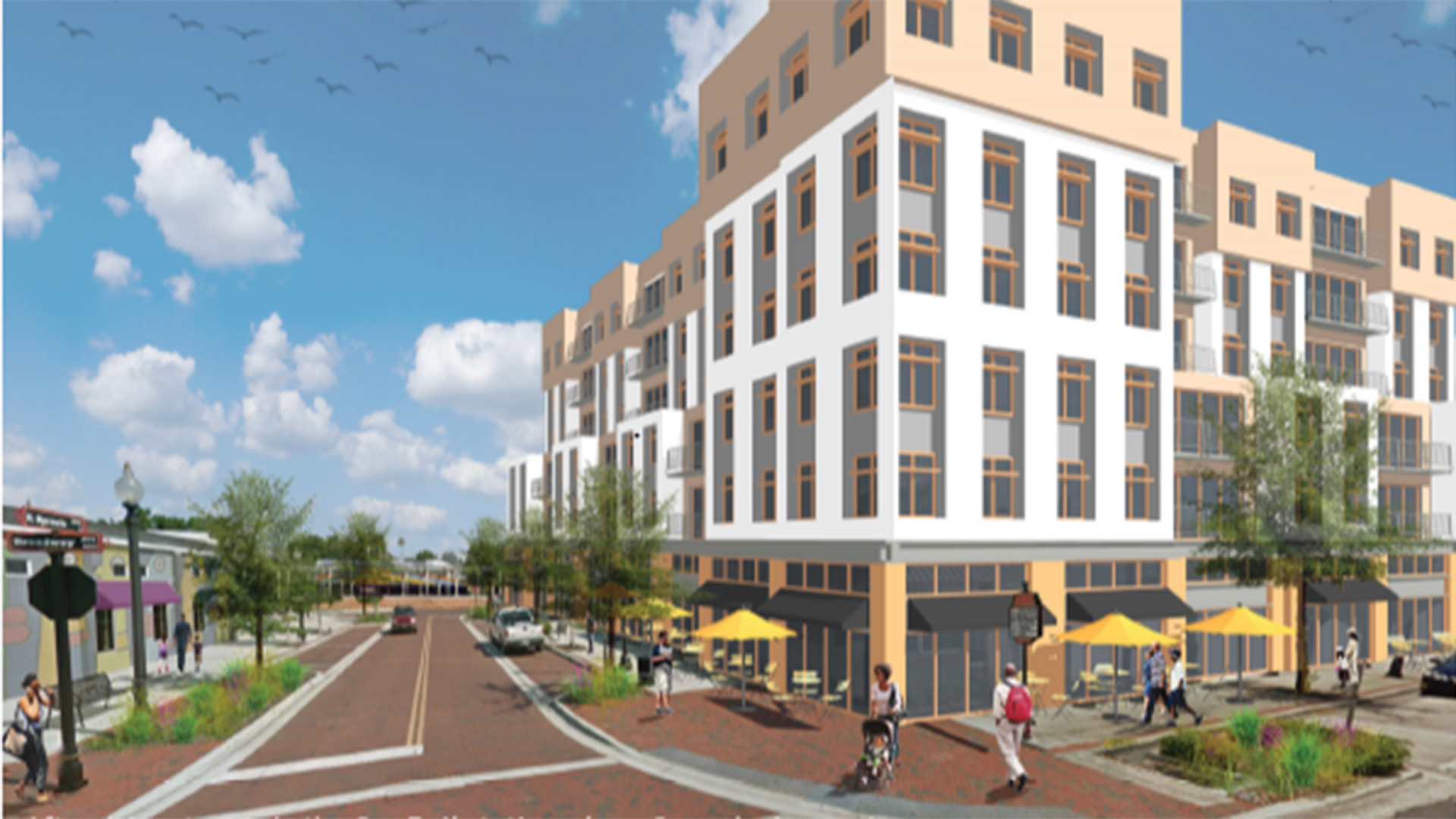
Our 3D visualization team developed 10 three dimensional roadway cross section models based on early concept illustrations. The visualizations illustrated different roadway alternatives and highlighted dimensions for travel lanes, sidewalks, landscaping, and bicycle facilities to support discussions around potential design approaches.
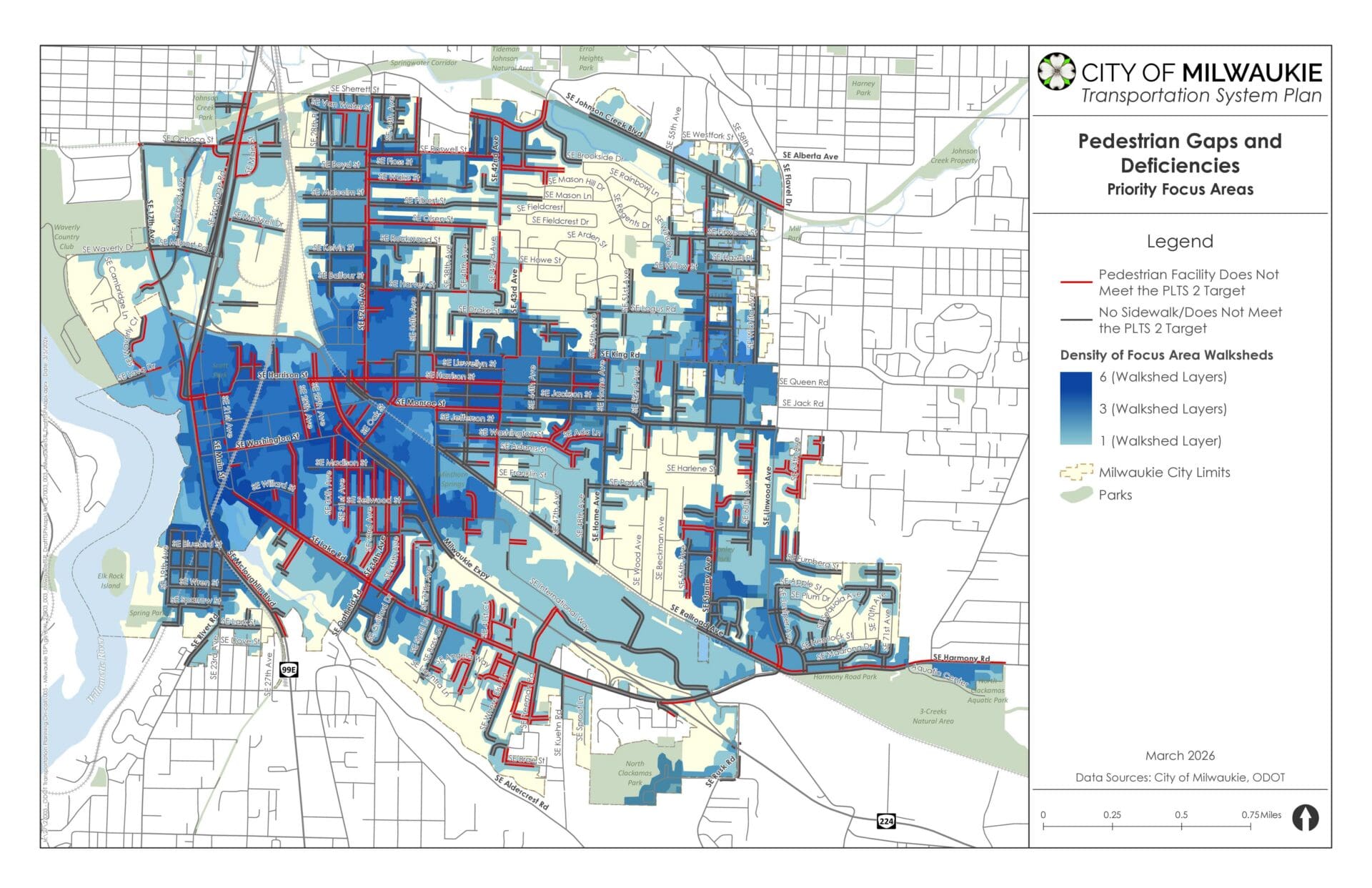
This map shows where projects should be prioritized. The black lines identified a gap; red means the area doesn't meet the target; and the darker the blue, the greater need for prioritization.
The Outcome
Bringing Oregon’s Updated CFEC Requirements into Milwaukie’s TSP
The Milwaukie TSP became an early example of how jurisdictions could begin responding to Oregon’s updated CFEC requirements within an active planning process. While the approach was developed specifically for Milwaukie and is not intended to serve as a one-size-fits-all template for other communities, the project provided valuable insight into how the new rules could be interpreted and implemented in practice.
The effort also contributed to a broader understanding of the differences between transportation system plans developed before and after the CFEC updates. Through technical analysis, policy interpretation, and close coordination with City staff, the project helped identify ways to incorporate multimodal priorities, project prioritization, and community engagement into an evolving planning framework.
Lessons learned through the Milwaukie process have informed ongoing conversations around transportation system planning in Oregon and helped support future projects navigating similar changes in statewide guidance.