
June 10, 2026

Five years after California began using vehicle miles traveled (VMT) as a primary measure of transportation impacts in environmental review, the change is still drawing attention beyond the state.
For agencies interested in reducing sprawl, supporting infill, and aligning transportation analysis with broader environmental goals, VMT is appealing. It introduces a different way of thinking about how land use decisions impact transportation systems and the environment: one that looks beyond local intersection delay and road capacity to ask the important question of how much total driving a project is likely to generate.
Has the shift to VMT led to the changes California policymakers envisioned when they adopted Senate Bill 743? Let’s examine what the Golden State has learned five years into the shift. As other states explore whether to make a similar move, California can now offer a clearer picture of what VMT can do, where it gets complicated, and what it takes to make it part of a broader transportation strategy.

VMT introduces a different way of thinking about how new developments impact their surrounding transportation systems. Photo credit: Pexels
Catch Me Up on California’s Adoption of VMT
When a development project undergoes environmental review, one of the key questions asked is how it is expected to affect the surrounding transportation system. Before 2020, the transportation impacts of new developments in California were measured primarily using traffic level of service (LOS), which focused on intersection performance. In practice, that typically meant looking at how quickly cars moved through intersections and whether expected traffic from a new development would push those intersections below acceptable operating standards. This meant projects in already busy, high-demand areas could be flagged for making congestion worse, even if those projects were located in places where people could walk, bike, take transit, or make shorter trips overall. And it meant mitigation centered on increasing vehicle capacity through measures like adding turn lanes, changing signal timing, or widening roads.
VMT offers a different lens. Instead of asking whether a project will add to congestion at a nearby intersection, it asks how much total driving that project is likely to generate (vehicle trips multiplied by trip length). In California, the change aims to reduce greenhouse gas emissions from driving and promote development patterns that more closely connect housing to jobs, services, and other destinations; essentially, infill instead of sprawl. For agencies looking for a performance measure that better supports multimodal planning and sustainable land use patterns, VMT sure looks like the golden ticket.
The Benefits of Using VMT in Environmental Review
Indeed, California’s shift from LOS to VMT has created some clear advantages in how agencies and practitioners think about project impacts. Here are a few benefits we’ve observed:
- The shift has expanded mitigation options in environmental reviews. In dense or built-out areas, LOS often penalized projects for congestion that developers had few realistic ways to fix. VMT allows agencies and developers to use strategies like better transit access, bike facilities, and transportation demand management (TDM) programs to reduce driving over time, easing some of the cost burden and friction that LOS created for projects in urban areas.
- The emphasis on VMT reinforces land use patterns that support shorter trips and a greater mix of transportation options. It encourages development in places where housing, jobs, services, and other destinations are closer together and can make higher-density development easier to support than it was under LOS. Together, these shifts can improve multimodal options and reduce greenhouse gas emissions, two of the biggest drivers behind SB 743.
- California is beginning to see the emergence of citywide and regionwide programs designed to address VMT at a broader scale. In some places, developers whose projects cannot sufficiently reduce driving through on-site changes (such as site design, transit access, bicyclist and pedestrian improvements, or TDM programs) to meet the project-level threshold can contribute to VMT reduction programs or “banks” instead, creating funding streams for larger transportation improvements. (We’ll touch more on this later.)
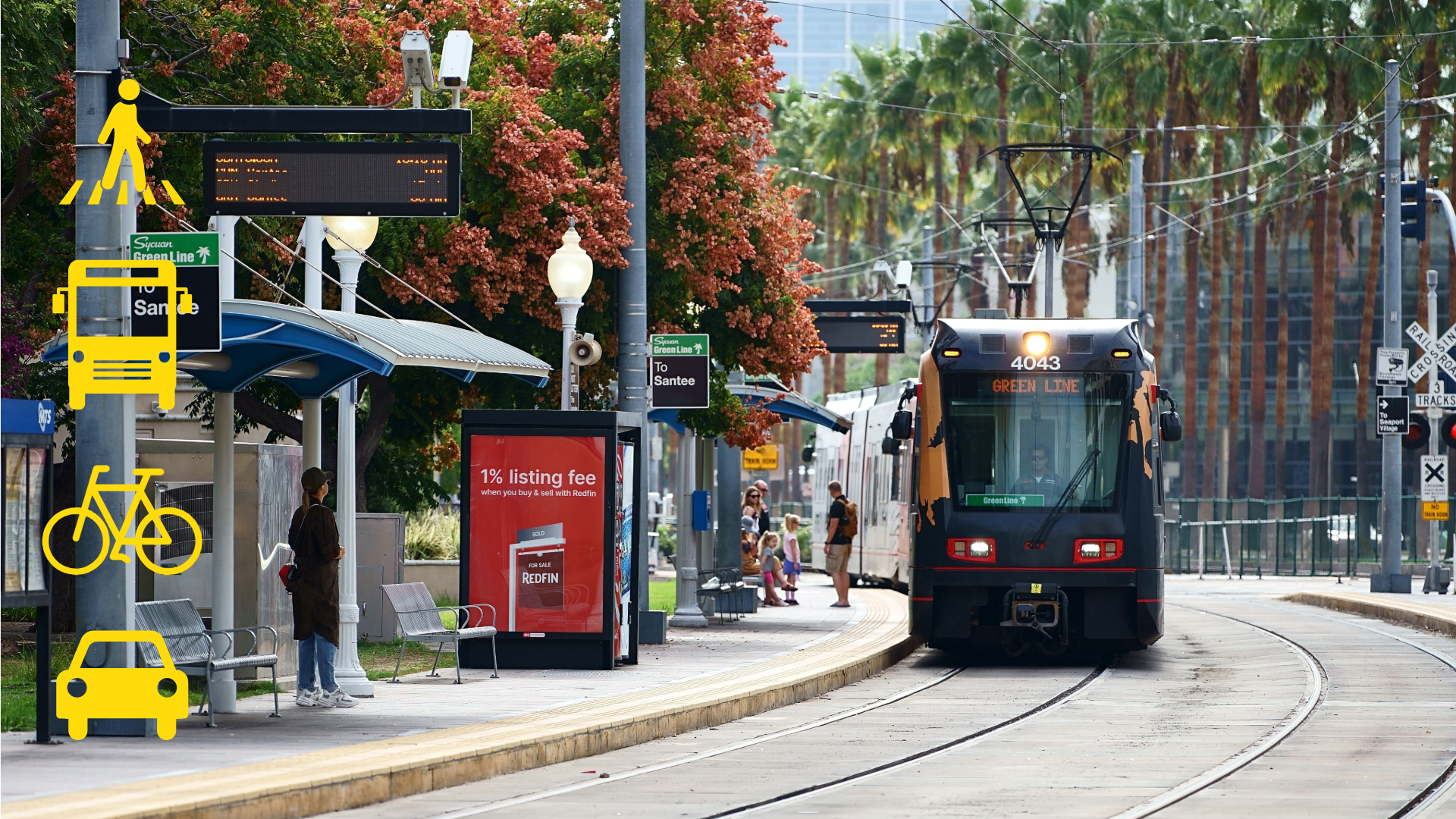
The emphasis on VMT reinforces land use patterns that support shorter trips and a greater mix of transportation options. Photo Credit: Pexels
Where VMT Gets More Complicated
Are Californians driving less because of SB 743? That is challenging to definitively answer. The predicted VMT of individual development projects can be modeled, but tracking whether those project-level reviews have translated to measurable statewide change is more complicated. California’s many local agencies do not all evaluate, monitor, or report outcomes in the same way, which makes apples-to-apples comparisons difficult. And because SB 743 is one piece of a much larger effort to reduce driving and greenhouse gas emissions, it’s difficult to isolate its effects from all the other factors shaping travel behavior.
Implementation has also been uneven. Local agencies had to decide how to implement the statewide guidance in their own contexts. One question cities faced was whether VMT should be measured against a local context or a broader regional model: an urban jurisdiction may already have relatively low VMT because of its density, while a regional analysis can pull in more spread-out travel patterns and lead to different conclusions. Embedded in this decision is the challenge that in smaller and less-dense communities, projects can be penalized simply for being located in high-VMT areas where mitigation is difficult to achieve in practice. Since low density areas further from the urban core tend to be less expensive places to live, VMT creates more hoops that housing developments in affordable areas have to jump through.
Additionally, did the year of the rollout catch your eye? Even though SB 743 was signed into law in 2013, California didn’t begin using VMT in development review until July 2020, a time when travel patterns were wildly disrupted by the pandemic. But even without that wrinkle, the process was never as simple as swapping one metric for another. Mitigation requirements triggered by environmental review under SB 743 may include not only one-and-done physical improvements, but also ongoing TDM programs. Those long-term strategies are important, but they are also challenging to administer. In many cases, projects commit to ongoing TDM measures on paper, yet there has been inconsistent follow-up to understand how those commitments are performing in practice.
In short: it’s complicated. VMT is a promising performance measure, but making it work consistently requires more guidance, capacity, and long-term accountability than its early promise may have suggested. Five years in, one of California’s clearest lessons is that the impact of VMT depends heavily on the point in the process at which it is applied, and at what scale. In other words: where and when.
Where: The Value of a Regional Look
In our experience, districtwide and regional efforts can usually do more to shape travel behavior than any one employer or development can alone. An employer can encourage transit use or offer commute benefits to their employees, and a developer can add bike parking, showers, or other amenities that encourage active transportation, but homebuilders cannot control where residents work and employers and businesses cannot fully dictate how employees and customers travel.
That’s why districtwide TDM programs, which coordinate strategies across properties and trip types, can be useful. For example, Spectrumotion offers commuting services and tools to people who live and work in Orange County’s Irvine Spectrum area, helping individual employers comply with TDM requirements in a way that advances a cohesive set of goals for the neighborhood—things like discounts on transit passes, carpool and vanpool incentives, and a free Emergency Ride Home program, all designed to reduce solo driving to work.
Stemming from SB 743, we’re beginning to see more large-scale VMT mitigation programs emerge in California. These programs provide ways for developers to fulfill VMT mitigation obligations beyond just constructing on-site improvements. For example:
- In the City of Escondido, if a project is found to generate VMT over a certain threshold, one way the developer can mitigate the impact is to construct an offsite transportation improvement from a list of identified VMT-reducing projects in the area, such as pedestrian and bicyclist infrastructure or transit-supportive upgrades.
- San Bernardino County Transportation Authority (SBCTA) is piloting a regional VMT mitigation bank. Projects, programs, and actions that reduce driving generate credits with monetary value. Development projects that need to offset VMT impacts can purchase these credits, and the proceeds are invested in more VMT-reducing initiatives and affordable housing.
- Similarly, the Western Riverside Council of Governments (WRCOG) has created a VMT mitigation exchange program through which development projects that need to offset VMT impacts (“credit users”) can purchase credits generated by agencies that implement VMT-reducing projects or programs (“credit generators”).
- In 2025, Assembly Bill 130 created the framework for a statewide VMT mitigation program, giving developers a new option to mitigate VMT impacts by contributing to a statewide Transit-Oriented Development (TOD) Implementation Fund that supports the development of affordable housing and related infrastructure in VMT-efficient areas.
In each of these cases, VMT mitigation looks like pooling resources to shape the broader transportation and land use system, leveraging the requirements established by SB 743 to advance TDM priorities.
When: VMT in Long-Range Planning vs. Development Review
Development review isn’t the only opportunity to consider VMT. In many places, VMT is used earlier in the process too, at the point when agencies are shaping long-range land use patterns and transportation systems rather than reviewing an individual parcel. For example, the Southern California Association of Governments (SCAG) uses VMT per capita (measuring average driving per person rather than total driving) as a performance measure in its Connect SoCal 2050 Regional Transportation Plan. Metro, the Portland region’s metropolitan planning organization, uses VMT per capita as one of three measures in its Regional Mobility Policy framework. When used iteratively at that scale, projected VMT can help planners compare different growth scenarios and ask which combinations of housing, jobs, services, and transportation options are most likely to support shorter and fewer vehicle trips in combination, all well before any individual development is constructed.
While VMT can still play an important role in development review, agencies should consider how the metric can tell a different story at the regional scale than it does for an individual project. A project may technically increase VMT on its own while still contributing to a larger plan that improves the jobs/housing balance, supports transit, or helps build a more complete community. In those cases, simply asking if the project generates VMT misses the point; the more important question is whether it is located and designed in a way that advances the broader system the region is trying to create.

Agencies should consider how VMT can tell a different story at the regional scale than it does for an individual project. Photo credit: Kittelson & Associates
For States Considering the Switch
For states considering the adoption of VMT as a performance measure in environmental review, California’s experience offers a few practical starting points:
- Be clear about what you are trying to achieve. Is the goal to reduce driving? Encourage infill? Support affordable housing? Simplify environmental review? VMT touches all of these goals, but they are not all the same. The performance measures, thresholds, and mitigation tools a state opts to use should flow from a strong and focused understanding of the outcomes that are most important.
- Plan for the implementation structure around the metric. In California, the California Environmental Quality Act (CEQA) is the legal framework behind applying VMT in environmental review; other states will need to decide whether a measure is intended to be informational, regulatory, or tied to a specific approval process. Adopters will also need a realistic plan for monitoring, enforcement, and technical support so that plans on paper translate to ongoing action.
- Treat VMT as one useful performance measure, not the only one that matters. In California, the shift away from LOS has elevated important questions about travel distance, land use, and multimodal access, especially in places where congestion was a poor proxy for overall transportation outcomes. But operations and safety still matter, and agencies still need ways to evaluate whether people can move through the system reliably and safely. Many California jurisdictions continue to require other types of traffic operations analysis outside the official environmental review process to understand which intersections and streets are most likely to be affected by new development (in addition to the VMT assessment).
Continue the Conversation
Hopefully you can tell from reading this article that we find this conversation fascinating. It’s the kind of strategic and analytical issue that echoes so many of the questions we help clients face as they try to find the right balance of accountability, flexibility, sustainability, efficiency, and desirability for their communities. Whether helping cities and agencies develop guidance in response to changing legislation and performance expectations, helping developers understand what VMT-based review requires in practice, modeling the predicted impacts of new developments, or supporting TDM programs at both the local and regional scale, these experiences have given us a practical view of what it takes to make a new performance measure workable. We’re always up for the next challenge; contact any of us to continue the conversation!