
November 18, 2026

It’s easy to know when a space feels good to be in: when there’s infrastructure designed for you, when communities and families can get around easily, when it’s vibrant and beautiful. It’s not as easy to spot how these spaces are cultivated.
Grassroots organizations contribute far more to helping public space thrive than we might realize. National, state, and local agencies are crucial to sustaining and progressing our transportation systems, but activist groups augment this work, providing irreplaceable resources that shape our everyday world and serve immediate community needs.
Today, we’re bringing this work center stage by featuring three nonprofits that make transportation safer, more sustainable, and more accessible: The Street Trust, Bike Bus World, and Depave. Leaders from these groups shared their stories with us, giving a window into how nonprofits function in the transportation industry, how they’re transforming communities, and how we can all pitch in to make a difference.
Opening Access with The Street Trust
In the Portland area, The Street Trust advocates for safe and accessible multimodal transportation that serves everyone, no matter their mode of travel, age, or ability. They provide resources, education, and events to expand transportation access and encourage policy changes and public investments.
Madi Carlson, Program Director of The Street Trust, fell into biking as a bike commuter with kids, then soon began leading walking and biking school buses.
“It’s hard to be a family biker and not become an activist and advocate,” she said.
Five years ago, Carlson joined the Street Trust part time to help with the Oregon Active Transportation Summit. Now, she manages their many programs and partnerships. Many of The Street Trust’s programs center biking, as it’s a mode of travel that’s efficient, clean, and community focused. Their programs are designed to foster belonging and build community, opening doors for people who don’t necessarily see themselves as bicyclists or feel welcome in other biking communities.
WeBike was one of the first programs Carlson worked on. It focuses on reducing barriers to biking and inspiring more women and gender-expansive people to bike. With group rides, bike clinics, and mentorship, the program shares knowledge and offers a built-in community, which encourages people to keep on biking outside of the program, whether it’s for exercise, recreation, transportation, or social connection.
WeBike is now completing its tenth year of programming. In that time, it’s grown to include bike camping clinics and trips. Funded by an Oregon Metro Regional Travel Options grant, these events are almost all free—the camping trip has a sliding scale to cover extra costs—with all materials and gear provided. On the camping trip, the group rides the MAX, the Portland metro area’s lightrail, to cut down the distance and then rides 20 miles to their campsite. By modeling a combo train-and-bike trip, the experience teaches people how to become multimodal commuters.
As Carlson put it, “When you can go camping with your bike, commuting feels a lot easier after that.” In fact, one participant was so inspired by the possibilities biking held that she got rid of her car after the trip.
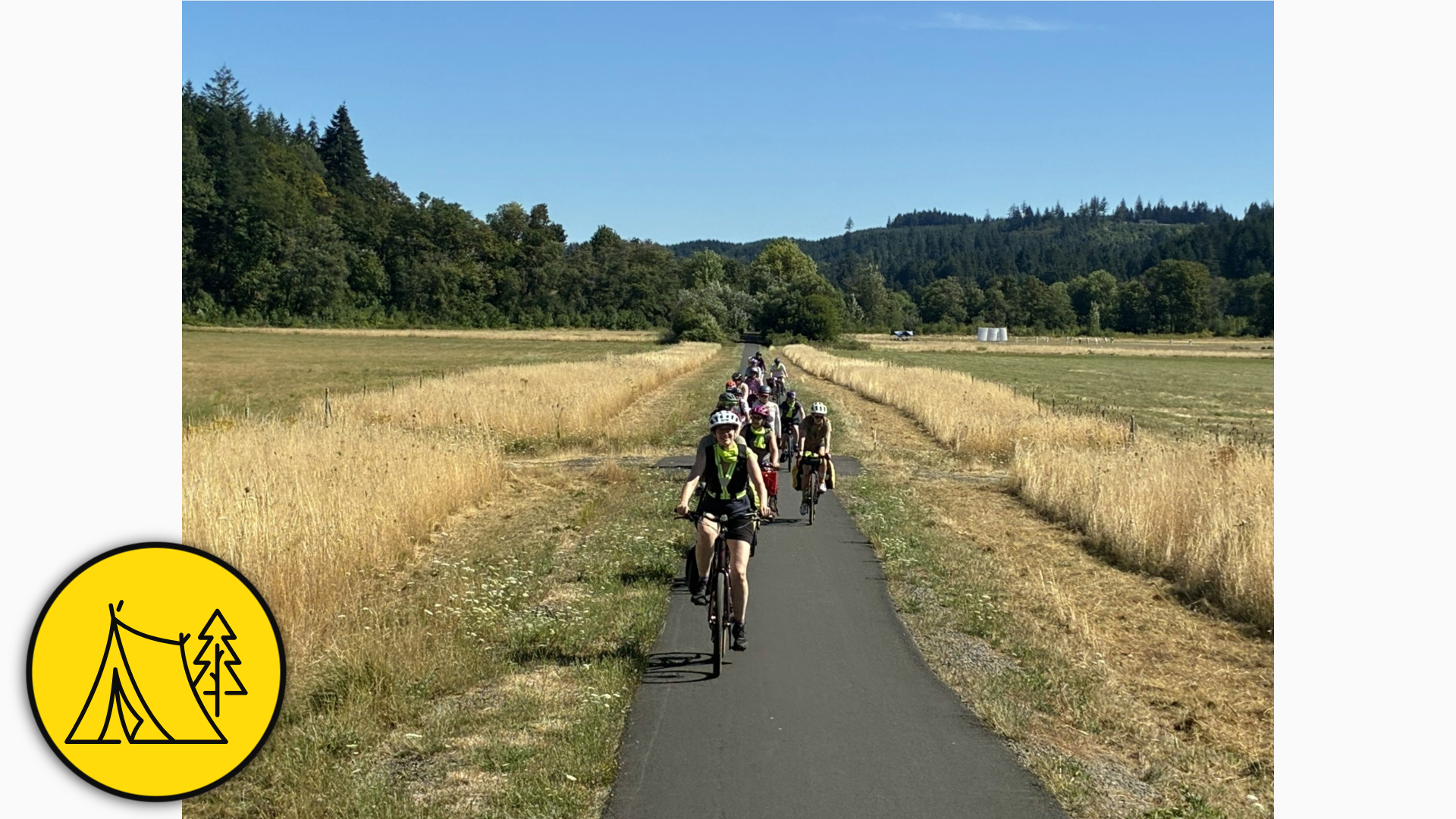
WeBike program participants bike to an overnight camping trip at Stub Stewart State Park. Source: The Street Trust
Another life-changing program The Street Trust leads is Ride2Own. E-bikes have grown rapidly in popularity, and for good reason: they help people travel longer distances more easily. For people who don’t have access to a car, an e-bike can make all the difference in being able to access employment, education, healthcare, community, and regular necessities—but it’s often these same people for whom the cost of an e-bike can be prohibitive.
Ride2Own gives free e-bikes to the people who stand to benefit most from them and equips them with the resources to use their bike safely and confidently. The program is structured in cohorts, with the first one kicking off in 2023. The Street Trust distributed 15 e-bikes to one cohort to ride wherever and whenever they wanted, and during the year-long pilot, they hosted bike repairs, clinics, and group rides.
Participants—75% of whom are BIPOC and all of whom have low incomes—label each trip on the NLR OpenPATH app for the year, and afterwards, keep their bike. The trip data helps The Street Trust understand what types of trips e-bikes are most useful for and to what extent e-bike use is replacing other modes of transportation. The Street Trust shares this data with the City of Portland to help influence infrastructure changes that meet demonstrated biking demand.
The program was so successful that the next year they established three cohorts in three Oregon cities, each with 25 participants. “It’s amazing to see the way a simple e-bike can change lives,” Carlson said, remarking on how the bikes allow people to get better jobs farther away.
Each year, The Street Trust adapts and improves the program to integrate feedback from past cohorts, whether it’s different gear or more training. The upcoming Ride2Own program will partner with an arts-based organization to reach teens 16 and up who have been impacted by incarceration, detention, or deportation. Access to e-bikes can help these teens—who often live in transit deserts—get to school and job opportunities, participate in extracurricular and community-building activities, and develop independence and confidence.
Beyond WeBike and Ride2Own, The Street Trust hosts free clinics and classes that help people incorporate active transportation into their daily lives, with some of the most popular being Bike Commuting 101, E-Bikes 101, and Grocery Shopping by Bike. Under an AARP grant, there’s also a new e-bike class for adults 50 and up. And these offerings are constantly adapting to demand: anyone can request a clinic.
Partnerships underpin much of The Street Trust’s programming. They’re partnering with Multnomah County’s REACH program to host a community transportation school, which educates people about the governmental structures behind transportation decisions so they can advocate effectively for the change they want to see on their roads. The course is also aimed at teaching folks running for public office about concepts like induced demand, which can then inform how they contribute to transportation policy and management.
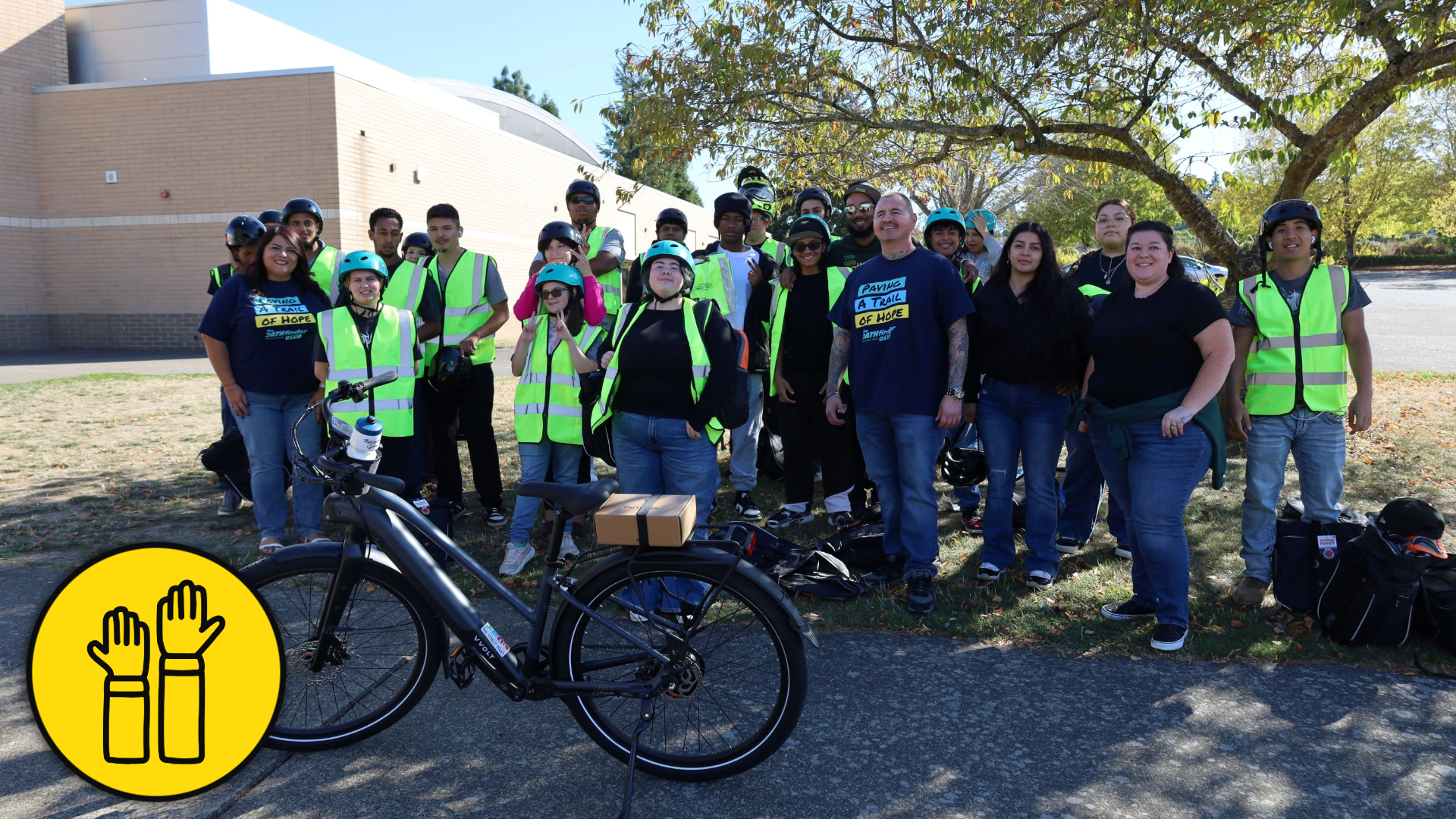
PATHfinder Club youth make up the newest cohort of The Street Trust's Ride2Own e-bike ownership program. Source: The Street Trust
Like most nonprofits, the primary barrier holding the Street Trust back from doing more is funding. Carlson shared how excited she and her colleagues are about each of their programs, and they hope that with more grants, partnerships, and program attendance, they can widen their reach further. Each person who participates in The Street Trust’s programs, even for one clinic, embraces multimodality, clean travel, and sharing our street space.
Uplifting Kids with Bike Bus World
While active transportation can be life-changing, it can also pose safety risks, especially for kids. One of the best ways to help kids learn to get around via bike safely is with “bike buses,” where adults guide children in a biking group to school. Kids join at set points along the ride, just like with school buses. The leading advocacy group for the recently popularized form is Bike Bus World, led and founded by Sam Balto.
In 2016, physical education teacher Balto led his first walking school bus in Boston. Even though just six kids joined, the impact he witnessed was profound: “That morning was so different from every other morning.” He was used to helping out with the before-school rush as a crossing guard or car line duty. Students arrived more energized and ready to start the school day after a physical and social activity, compared to after sitting in traffic. Not only does walking and biking to school help kids learn to be safe road users from a young age, but it also increases children’s independence and confidence, creates community, and promotes healthy exercise.
Balto went on to lead walking school buses in Boston and then Portland for six years. Then, on Earth Day of 2022, he led his first bike bus in Portland, inspired by Barcelona’s bicibús movement. That day, 75 students joined the bus. Afterward, the kids insisted it continue—and for the next four years (and counting), there’s been a bike bus every Wednesday.
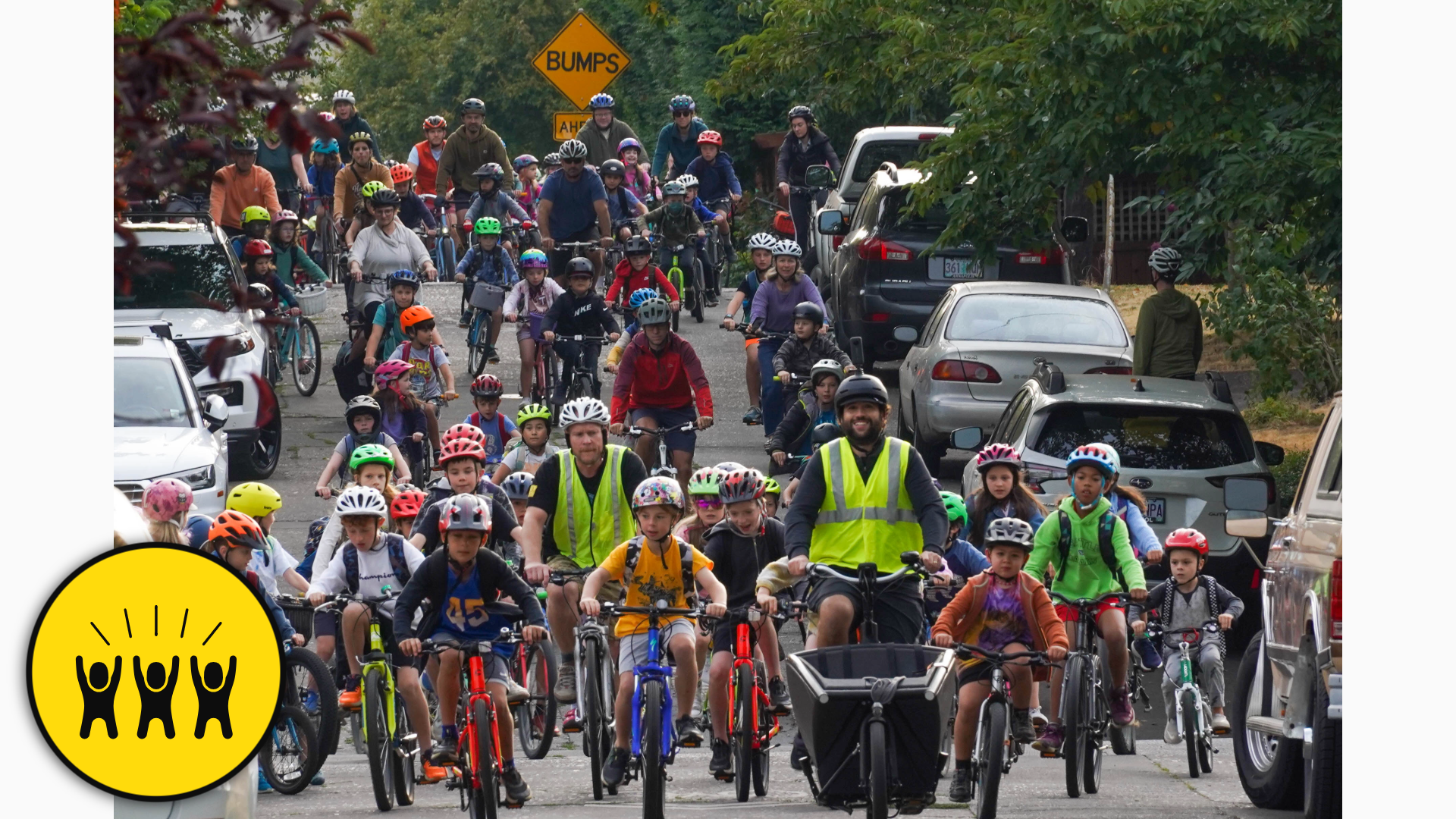
Sam Balto leads Alameda Elementary School students and parents in a 75-student bike bus on Earth Day in 2022. Source: Jonathan Maus / BikePortland
In 2023, Balto began working to create the international nonprofit Bike Bus World, and in 2024, he left his role as a physical education teacher to work at the nonprofit full time. With Bike Bus World, Balto travels—you guessed it—the world, promoting and riding in different bike buses, supporting existing leaders, and coaching new leaders. While the organization offers online resources, webinars, and free one-on-one coaching, they emphasize the flexibility of bike buses and encourage leaders to make the idea their own.
“There is no boss of the bike bus,” Balto said.
But with so much hype around bikes, Balto wants to make sure the story’s straight: “We love school buses. It’s everything against school car lines.” Biking, walking, and using transit are all equally good—the vision is using active transportation to improve student performance, build community, and relieve traffic jams.
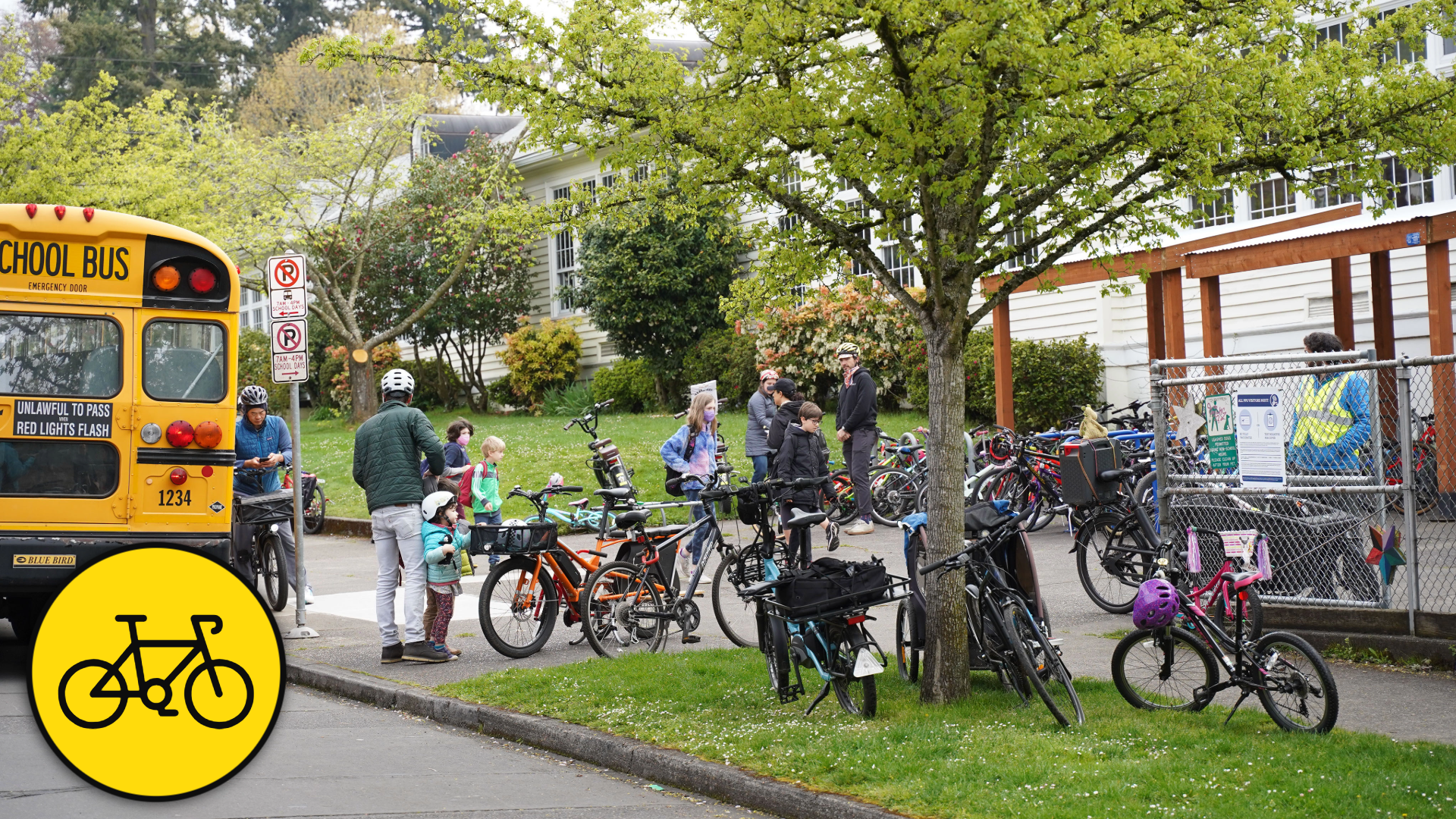
Alameda Elementary School students and families park their bikes, while a school bus offers another multimodal commute option. Source: Jonathan Maus / BikePortland
Balto explained that consistency is one of the most important determinants of a bike bus’s success. For students and families to make bike buses a practical part of their routine, they need to be able to rely on a regular day, time, and route. Balto advised that people be kind to their future selves when establishing a bike bus—that is, set up the bike bus in a way that makes it easy to keep doing it. Having a bike bus once a week or once a month for years can have far more of an impact than a daily bike bus that only lasts a few weeks.
“Children aren’t looking for perfection,” he said. “They’re looking to be seen.”
To start a bike bus, Balto explained, you need five things: to teach kids to bike, to get bikes for kids, to find secure bike parking at school and home, to have a basic level of bikeable infrastructure, and to compensate leaders. On that last point, relying on volunteers to run bike buses can be inequitable and unsustainable, breaking down the consistency that is so essential for bike buses to function. While dollar-for-hour compensation is ideal, stipends, gift cards, and even just regular shows of thanks make a big difference.
Balto pushed back against the notion that nobody uses bike infrastructure. In the first three months of leading bike buses, Balto moved his elementary school from 1% of students riding bikes to a third. This was powered by just a $500 mini grant, a common activism resource for Safe Routes to School, that funded bike equipment. While the physical streetscape didn’t change, the social infrastructure of a bike bus provided a way to use existing roads safely. And the results go to show how much people would take advantage of on-the-ground improvements, too.
“The community shows up when there’s infrastructure they feel safe using,” Balto said.
Bike buses aren’t the end goal; they’re more of an interim solution to make biking on today’s streets safe for children. Bike buses rely on adult guides and safety in numbers so the group can take up the whole road, forcing drivers to slow down. But looking to the future, Balto wants to see our streets be safe enough for anyone to ride, anytime. Hardened barriers that create separated bike lanes are safer for everyone, and they can allow kids to ride safely without reliance on adults.
Every year, five or so kids or parents tell Balto that they learned to ride a bike through a bike bus. He believes that bike buses teach kids that the street is for them and that they’re allowed to take up space. Helping kids bike to school shows them that biking can be more than recreation: it can be functional transportation that opens up access and opportunities.
(For more on the wonders of bike buses, check out our previous article about their history, impacts, and ways to get involved.)
Creating Green Streets with Depave
While The Street Trust and Bike Bus World prioritize mode-shift programming, a third nonprofit, Depave, focuses mainly on changing infrastructure. Also based in Portland, Depave addresses environmental and social issues by transforming public spaces. Their focus is simple: they replace pavement with community green spaces. From here, their goals branch: mitigating urban heat impacts, promoting active transportation, reducing pollutants, providing gathering and play spaces, improving road safety, and even creating jobs all play a part.
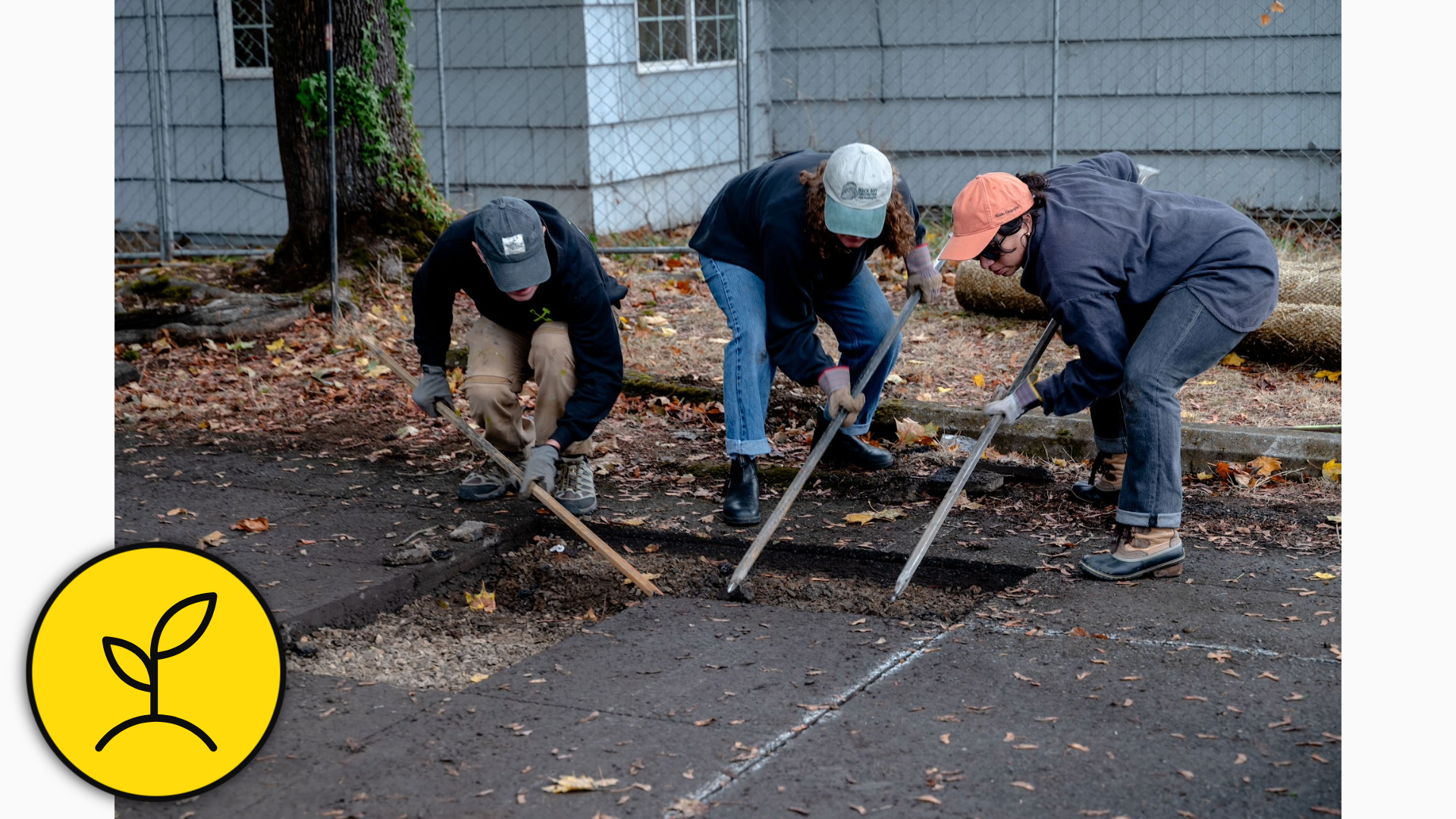
Three volunteers remove pavement outside Portland’s Bikeworks, a social purpose bike shop run by nonprofit p:ear, as part of a depaving event in 2025. Source: Elle Hygge
Leading the organization is Malena Marvin, the Executive Director. Prior to running Depave, Marvin ran a small business as a social entrepreneur. She also had rich exposure to environmental work: she studied ecological design and residential graywater systems, worked in field-based wilderness education, and—of course—was a lifelong biker.
Marvin explained that the organization’s mindset is one of solving many problems with a single project, in contrast to bureaucratic agencies that are often focused on one problem at a time. Teaming with a variety of ecological, social, and neighborhood groups, Depave is all about advocating for more holistic ways of looking at urban design.
Many people are so used to pavement all around them that they don’t even notice it’s there. But our cities look this way for a reason. Paving over land is often cheaper in the long term than landscaping green spaces because it requires so little maintenance. The choice of where to pave rather than plant isn’t random: Portland sees a huge disparity in tree cover between wealthy and working-class neighborhoods, leaving low-income residents more exposed to heat dome effects. Another effect of all this pavement? Rain washes oil, chemicals, and other pollutants off paved areas and into our waterways, damaging river ecosystems.
Depave tries to reverse this development pattern. They partner with site hosts like schools, churches, and community centers who want to revitalize their underutilized paved areas. Because demand outpaces their resources, Depave prioritizes projects in neighborhoods that are disproportionately impacted by urban heat. With volunteers, Depave tears up pavement and replaces it with native plants, picnic areas, sensory play spaces, and shade trees.
“When you go from having a paved over lot … to a dynamic, multifeatured, cool, green landscape,” Malena said, “you find that not only are there enhanced ecological services but also community starts to thrive through access to play structures and nature play, gardening, and picnic and barbecue areas.”
These spaces quickly become hubs, offering safe, pleasant, outdoor areas that may not have been accessible to locals before. Replacing gray infrastructure with green even just for a few hundred square feet also cools the area and filters harmful chemicals out of stormwater as it flows into our rivers. Plus, trees in streetside areas can help slow traffic speeds and improve pedestrian safety.
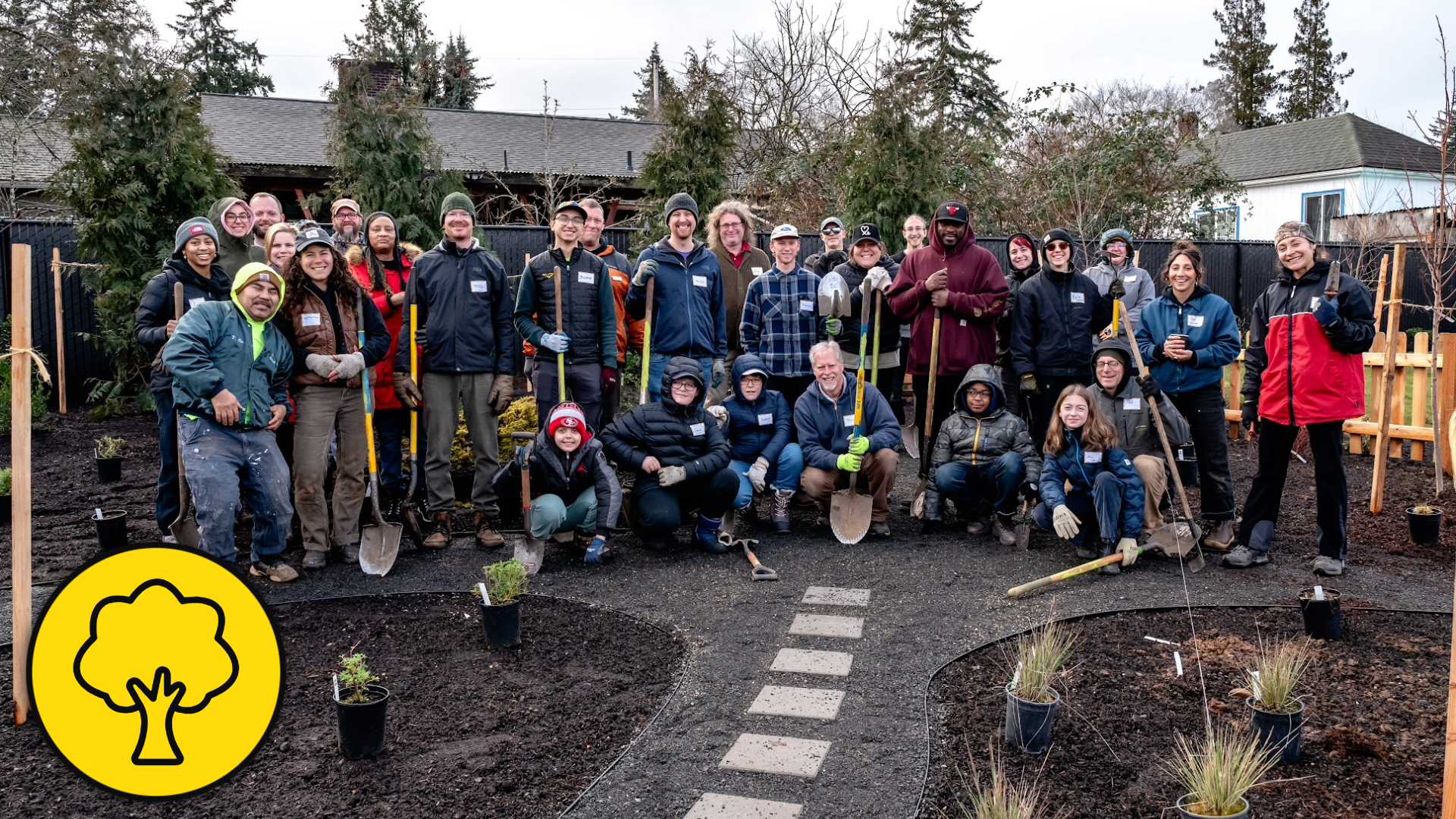
Volunteers and Depave staff transformed an asphalt lot into a planted haven outside Morning Star Church on March 8, 2025. Source: Elle Hygge
Depave’s largest project is underway right now, at the five-way intersection of 7th and Sandy in Portland’s Central Eastside. In partnership with the Portland Bureau of Transportation, they’re turning the large intersection into a Complete Street plaza with green traffic-calming infrastructure and dedicated bike access.
Bringing community-based perspectives to a capital project in the public right-of-way helps major infrastructure respond sensitively to local needs. Depave brought in community members by hosting design charettes and street block parties, as well as by speaking to neighborhood associations. Collaboration between government and grassroots involves a lot of planning and communication, but it (de)paves the way for a better system, where the people who use infrastructure are a real part of designing it.
These kinds of spaces require regular maintenance, but Marvin shared how this can be a good thing. For Marvin, green landscapes mean jobs, and she believes that employing people to tend depaved areas could help address some of Portland’s housing challenges. Marvin envisions a future where ecological and social change can reinforce each other, all while making our cities more enjoyable places to be.
To actualize these changes beyond what they can do alone, Depave works with other advocacy groups as part of the 11-group Building Resilience Across Northwest Communities & Habitats (BRANCH) Coalition. These organizations can stack resources and funding at a site to provide more features, like rain gardens. Partnering with other organizations like Cultivate Initiatives, Ground Score Association, and p:ear, which help people build life and job skills, prepares under-resourced individuals for careers in landscaping and tree care. This incentivizes the development of green infrastructure and opens job pathways that are accessible without higher education.
The largest barrier to all this work is financial. Depave implements projects primarily with public grants from programs like the Portland Clean Energy Fund, but complex municipal grant application and reporting processes impose a large administrative burden on small, community-driven nonprofits. Marvin sees an opportunity to remove barriers to funding by fast-tracking environmentally focused projects.
“I always believed the design of our cities sets the pattern for how our society interacts with the world,” she said. “Through design we can change the world.”
Inspiration and Motivation
These nonprofits represent a broad swath of advocacy for transportation. Whether it’s active transportation accessibility, safe child mobility, or sustainable streets, they all find ways to improve transportation opportunities for everyone, especially those who need them most.
But the story doesn’t end here. There are organizations like these across the country—and world—each with their own story to tell. From Riders Alliance advocating for better transit service in New York City to Trailnet establishing low-stress walking and biking infrastructure in St. Louis, Missouri, there are people making change wherever you are.
Activist organizations are almost always looking for more hands and voices. You can reach out to The Street Trust, Bike Bus World, or Depave, or find a group near you that focuses on what you’re passionate about and see how you can help. Together, we can shape how our public spaces look and feel from the ground up.