
August 12, 2026

Lessons from Velo-city 2026
The Grote Markt in Mechelen, Belgium feels like the quintessential European plaza: an ornate town hall, preserved Renaissance-era houses, cafes where patrons sip cappuccinos and take in the bustling atmosphere. For someone visiting from the U.S., it’s easy to walk through a place like this and assume it has always been this way—that it belongs to a different category of city, one built before cars and therefore spared the transportation tradeoffs American communities face every day.
I was stopped in my tracks at the 2026 Velo-city Conference when I learned that, until 2005, this beautiful plaza operated as… a parking lot! It’s actually one of many examples of European gathering spaces that have been reimagined from parking lots to pedestrian plazas in just the last 20–30 years. While I went into the conference expecting to draw tidbits of inspiration from the storied but unattainable bicycle transportation culture in many European cities, what I heard both surprised and encouraged me. Europe’s transportation challenges are not as different from ours as many Americans assume, and the steps they’ve taken are well within our realm of possibility. If you keep reading, I think you’ll be encouraged, too.
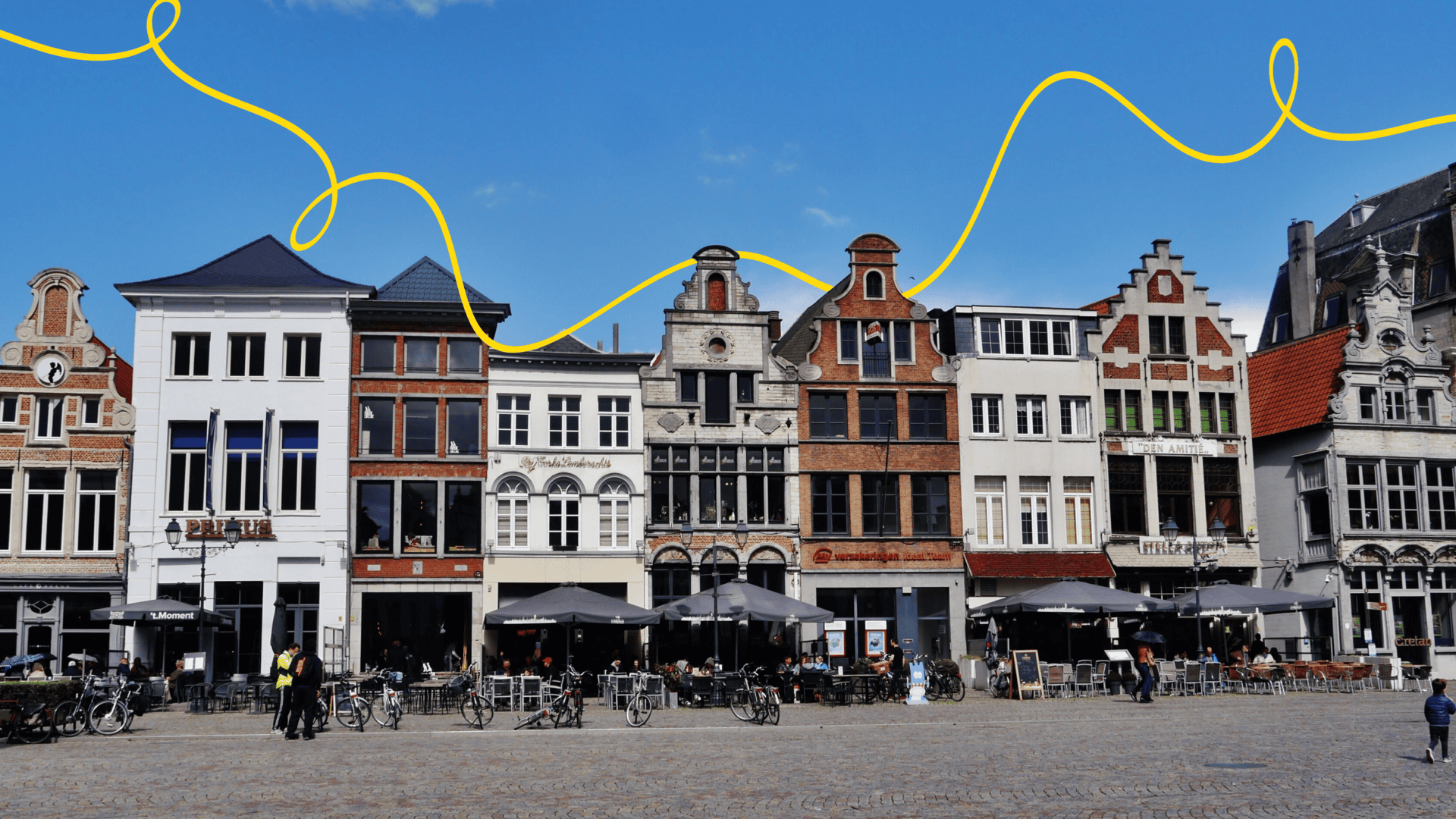
Mechelen, Belgium’s charming Grote Market. Source: Mechelen Grote Markt 06 by Zairon, CC BY-SA 4.0.
Before We Say, “That Won’t Work Here…”
When a community considers a change, decision makers often ask for examples of how that change has worked somewhere else. But when those examples are provided, they’re easy to dismiss. A larger city is too different. A smaller city is too different. Even the neighborhood next door is too different. We can always find a reason why an example doesn’t apply to our situation.
This skepticism around case studies (despite how many of them we continue to demand) is even more pronounced when an example comes from another country. From a transportation perspective, we tend to think of Europe as a fundamentally different place. Bicycle ridership statistics from the Netherlands, Belgium, Sweden, and Denmark are inspiring, but feel irrelevant to the challenges we face with car-centric street design in the U.S. We dismiss such examples with the assumption that European cities are older, denser, more culturally predisposed to walking and biking, or just… too different.
The Velo-city Conference is one of the transportation profession’s premier events for active transportation enthusiasts. Earlier this summer, the 2026 conference drew more than 1,500 participants to Rimini, Italy to swap stories and talk strategies around the conference’s theme of delivering the urban dream. It was exactly the type of environment where you’d expect to hear from cities whose active transportation systems feel impossibly far ahead of ours. I’ll admit I arrived with tempered expectations. Prepare to be dazzled and a little envious, then return home to very different conditions. But the kind of inspiration I came home with wasn’t just the reach-for-the-stars-and-everything-is-possible kind. It was a surprising sense that European cities face the same challenges we do.
No matter its mode split, every city holds an array of competing opinions about how streets and public spaces should be used. But there are cities that move forward anyway. I listened eagerly to pick up on the commonalities of cities that have successfully created vibrant cultural and gathering spaces in plazas that were, until recently, seas of parked cars.
The Myth of the Timeless European Plaza
The Velo-city Conference rotates through cities that reflect the European Cyclists’ Federation (ECF)’s focus on advancing more and better bicycling across Europe. In addition to being a charming backdrop on the Adriatic Sea, Rimini is itself a living picture of what happens when you make choices elevating placemaking, safety, and more dynamic movement in city centers.
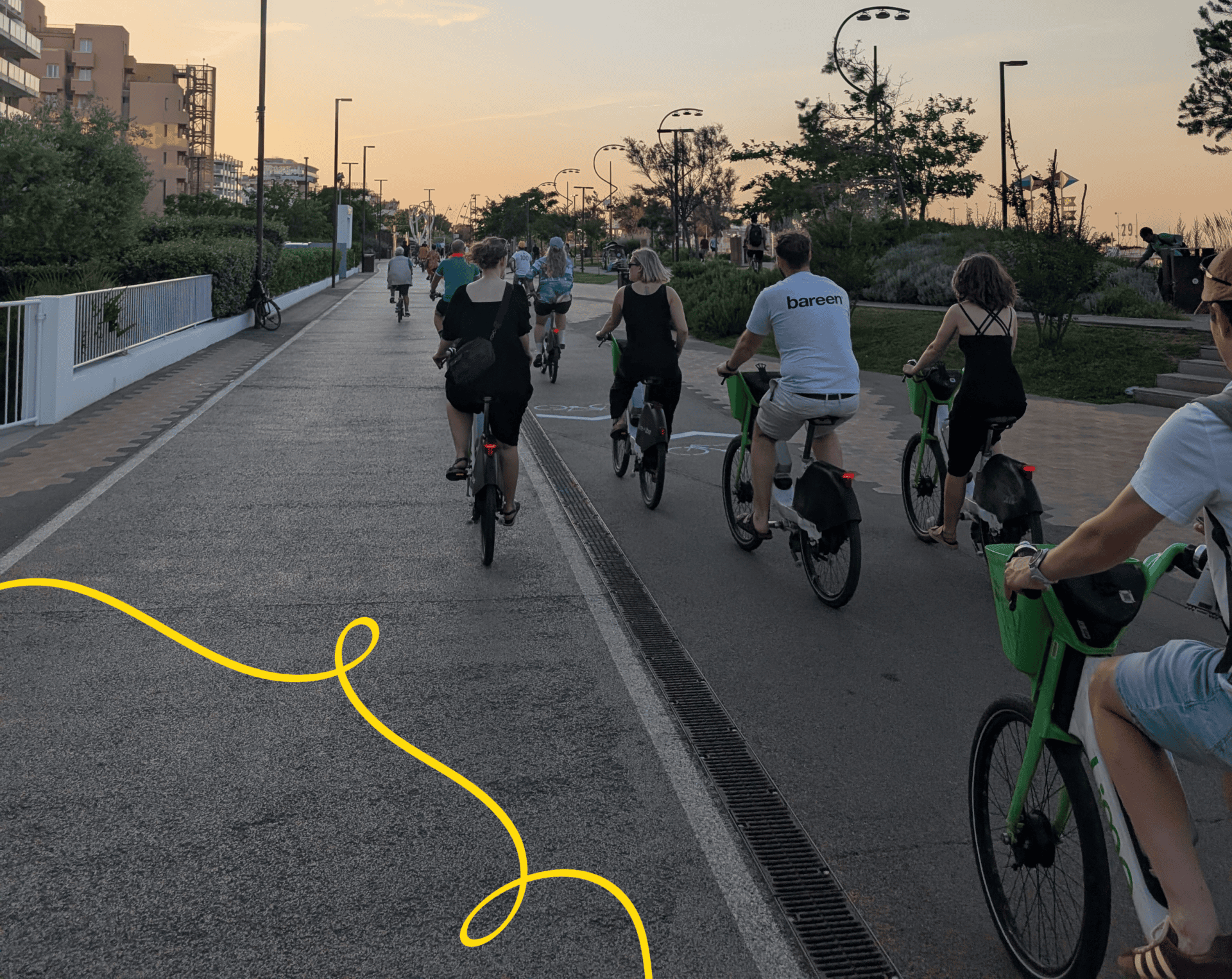
Rimini, Italy is a living picture of what happens when you make choices elevating placemaking, safety, and more dynamic movement in city centers. Source: Kittelson & Associates.
As I explored the city for myself (gotta do my research, of course), one of the attractions I visited was the Piazza Malatesta, where Castel Sismondo rises tall behind fountains, greenery, and a water play area designed to mimic the castle’s moat. I was struck by the vibrancy of the square and the dancing water features, not knowing it was about to be featured in the conference’s programming as an example of a recent placemaking transformation. Imagine my surprise when I learned that the Piazza Malatesta just became car free in 2021! Before that transportation, much of the space functioned as parking.
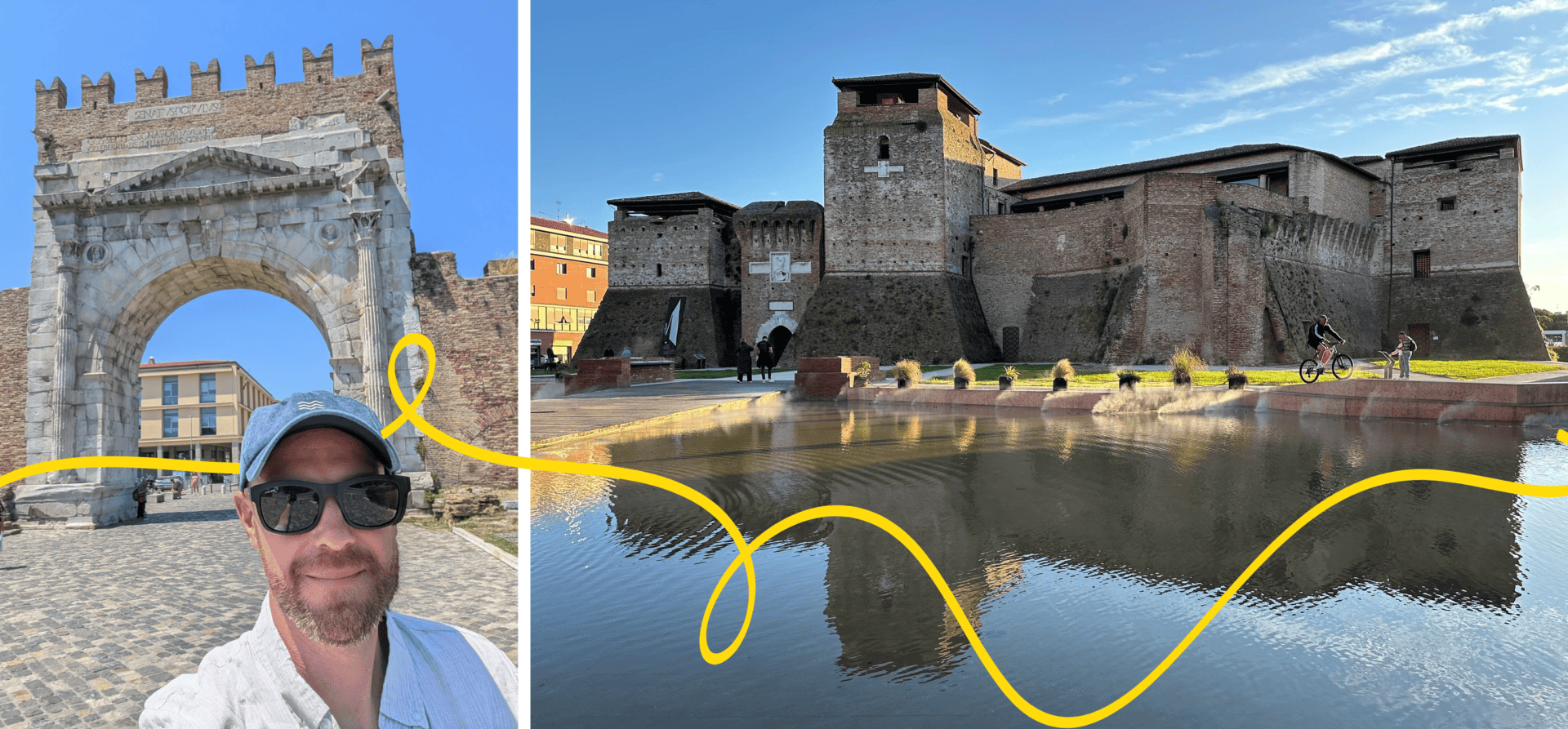
Left: the ancient Arch of Augustus. Right: Piazza Malatesta. Source: “Rimini” by Sergei Gussev, CC BY 4.0.
Another Rimini must-see is the 2,000-year-old Tiberius Bridge. No, that’s not a typo. The bridge was constructed under Roman Emperors Augustus and Tiberius between A.D. 14 and 21. It’s so well built and preserved that according to a presentation from Rimini’s Mobility Sector Manager Carlo Michelacci, just a few years ago, it was accommodating 13,000 cars per day. But while that’s wildly impressive, it meant this historic gem was simply the site of stop-and-go traffic.
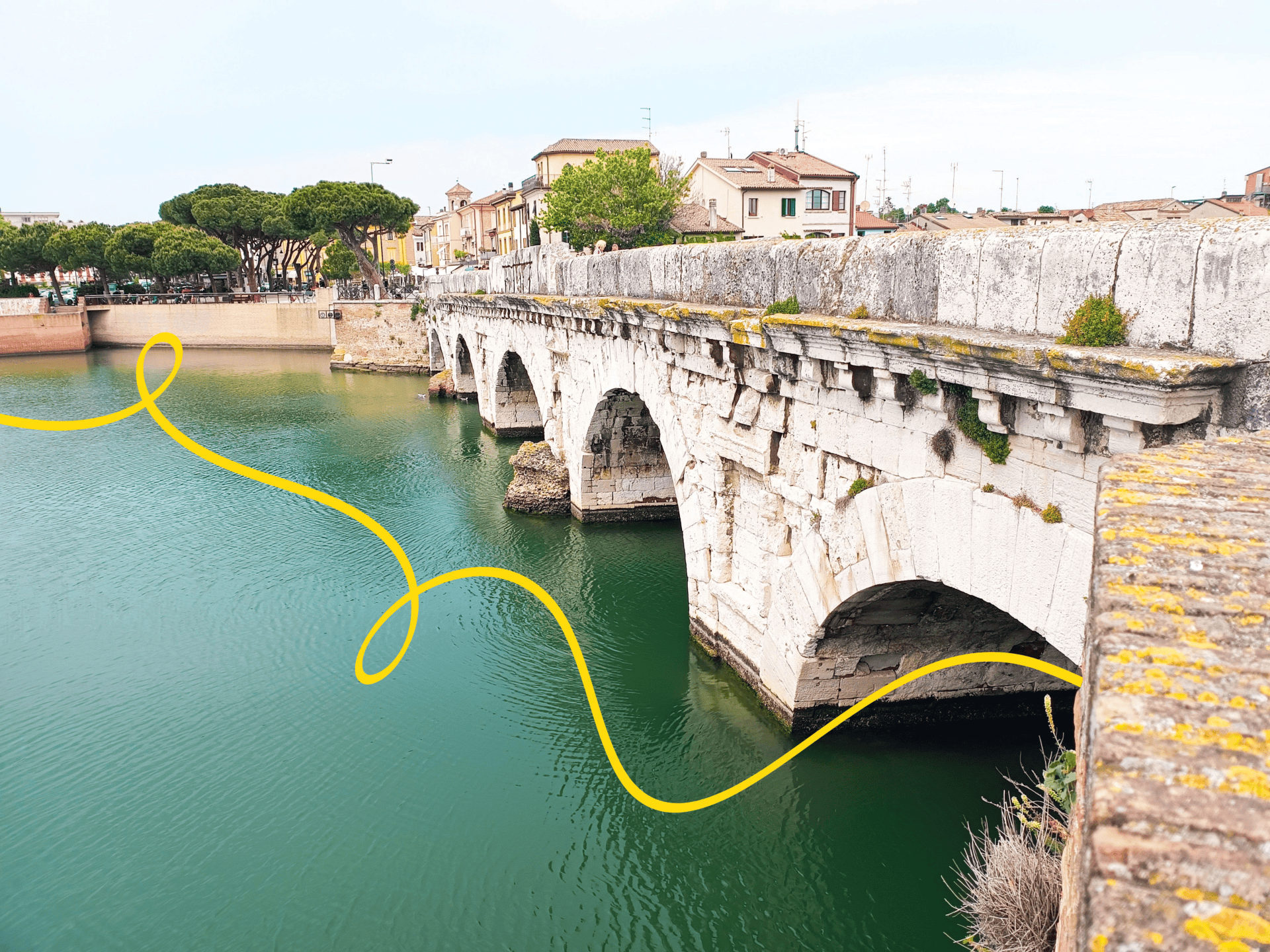
Until 2019, the 2,000-year-old Tiberius Bridge accommodated 13,000 cars per day. Source: Piotrek Wilk on Pexels.com.
In 2019, a pilot project closed the bridge to cars and repurposed it as a bicyclist and pedestrian zone, a change that has since been made permanent. The third day of the conference concluded with a dinner party next to the bridge, and the photo I took (below) doesn’t do full justice to the lively atmosphere I experienced.
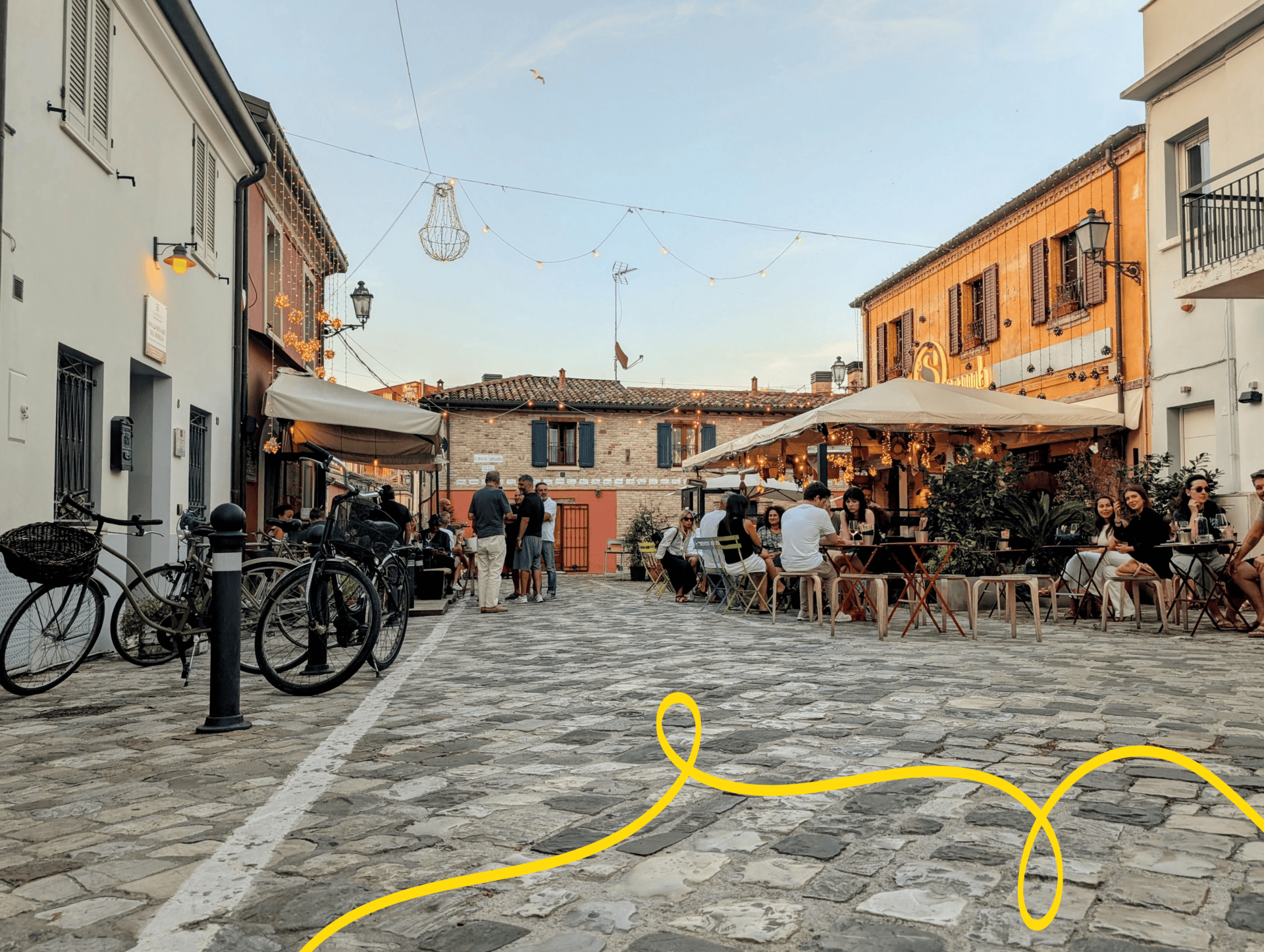
Snapshots of the conference’s dinner party right next to the Tiberius Bridge. Source: Kittelson & Associates.
The Piazza Malatesta and Tiberius Bridge served as living examples of what I was hearing at the conference. Beloved public spaces may feel natural, even inevitable, but they exist because of decisions about who and what public space is meant to serve.
A Choice, Not a Calculation
When asked what technical analysis they completed in the decision to make the Tiberius Bridge a pedestrian zone, the City of Rimini responded, “It was just a choice we made.” Of course, technical analysis was employed to help them plan for the impacts of closing the bridge to cars, but they didn’t wait for a number in a report to guarantee that closing the bridge would be frictionless.
This was a theme I heard over and over in conference presentations. Change is always hard; sometimes you have to take chances. At some point, a city has to decide what it wants its streets and public spaces to do.
“First, you must decide what kind of city you want to build and set a clear, unambiguous goal,” says Carlo Michelacci. “Once that vision is set, the single most critical step is transparent communication with the community. The challenge for leaders is learning how to distinguish between valid, constructive feedback—which should be embraced to improve the project—and plain resistance to change.”
If the highest priority is making driving and parking as easy as possible, then goals like safety, street life, cleaner air, quieter neighborhoods, and more inviting public space will be forced to work around the edges. Mechelen (the example I opened with) shows us one version of a different choice. Cars can still enter the city center, but they can no longer use it as a through route; paired with improvements around the center, that decision has shifted the balance of the street network toward more walking, gathering, and lingering. Transportation must serve the kind of place a city wants to become, not the other way around.
“When people see a genuine vision and feel heard, even non-believers begin to trust the process,” says Carlo.
“When people see a genuine vision and feel heard, even non-believers begin to trust the process.” – Carlo Michelacci, Manager of the Mobility Sector of the Municipality of Rimini
But… U.S. and European Transportation Networks Are Different
It’s fair to pause here and point out that if you clear out a surface parking lot in Los Angeles, you’re not exactly going to reveal a collection of centuries-old architectural treasures. U.S. and European transportation networks do have notable differences because the cities they’re built upon are different. So no, our goal isn’t to make every pedestrianized place look like a postcard from Belgium.
The lesson I took away from Velo-city 2026 is that public space can be used differently when a city is willing to make a different choice. During the COVID-19 pandemic, communities across the U.S. saw streets, curb lanes, and parking spaces become outdoor dining areas, gathering places, and temporary pedestrian zones. They did not all look like European plazas, but they created their own unique environments, responding to demand that was already there.
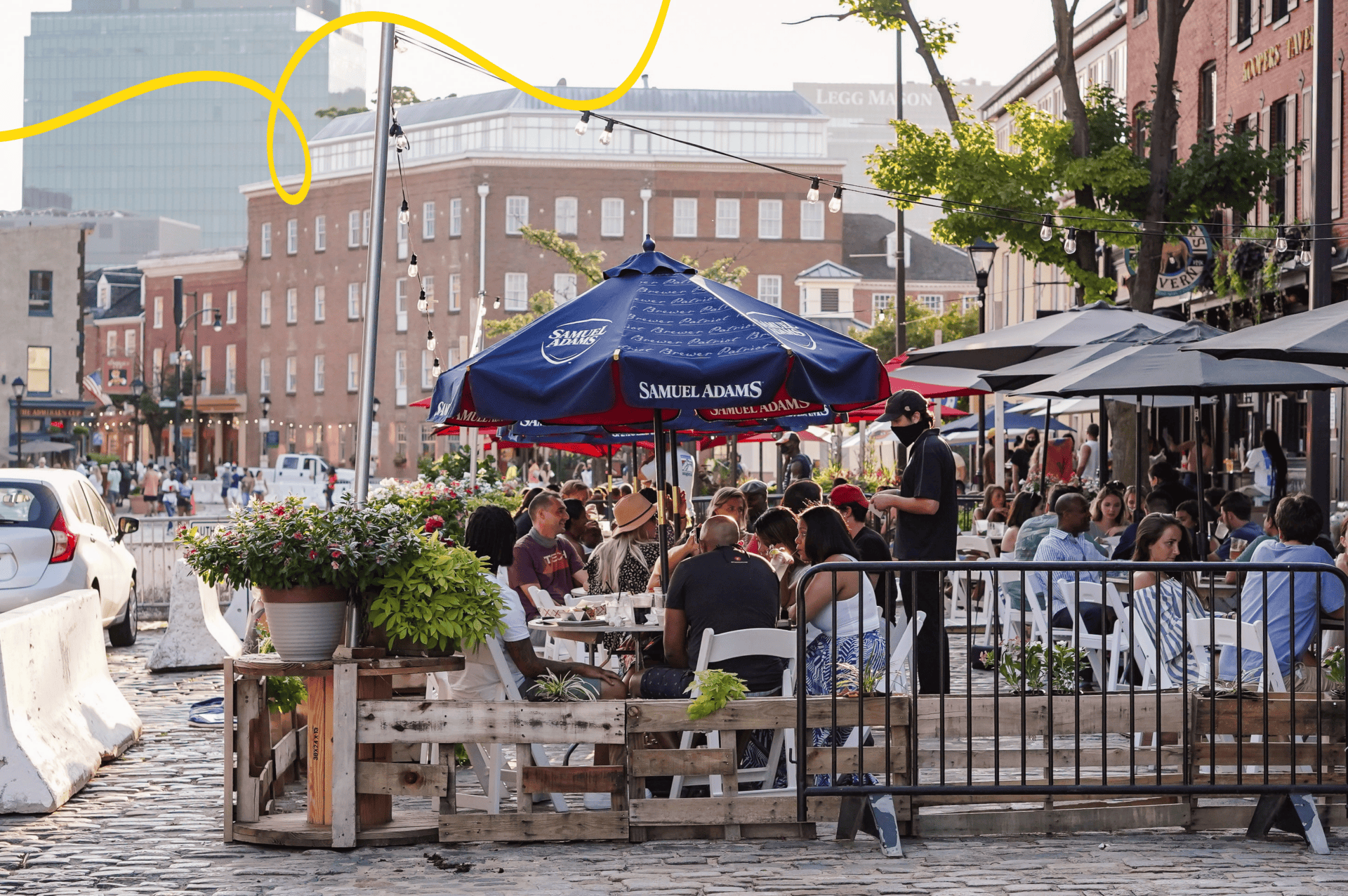
An outdoor dining parklet in Baltimore, MD during the pandemic. Source: Kittelson & Associates.
The U.S. has different land use patterns, wider roads, and a deeper dependence on driving in many places. But we also have plenty of streets where people are already walking, shopping, dining, gathering, and lingering despite designs that make those activities feel secondary. In those places, the question is whether we are willing to see them for what they could become.
I was shocked how much time in Velo-city sessions was dedicated to the concept of addressing bikelash. Wait—not everyone in Copenhagen bike commutes when it’s snowing? The presentation material I heard sounded surprisingly similar to conversations I’ve had in Association of Pedestrian and Bicycle Professionals (APBP) and National Association of City Transportation Officials (NACTO) sessions time and time again. Every city deals with vocal opposition when they investigate reallocating driving space to other uses. The cities that have created the spaces people want to be—whether charming plazas, car-free bridges, or outdoor dining zones—are the ones that have intentionally gone after a vision.
Technical analysis should help leaders evaluate tradeoffs, understand safety implications, and manage change. But when we put it in the driver’s seat of community planning, we can’t be surprised when we struggle to move the needle on placemaking. We’ve turned the choice between a community gathering space and a parking lot into a transportation engineering decision, but I’m not sure it’s fundamentally a transportation decision at all. It’s a decision about what kind of place a city wants to become.
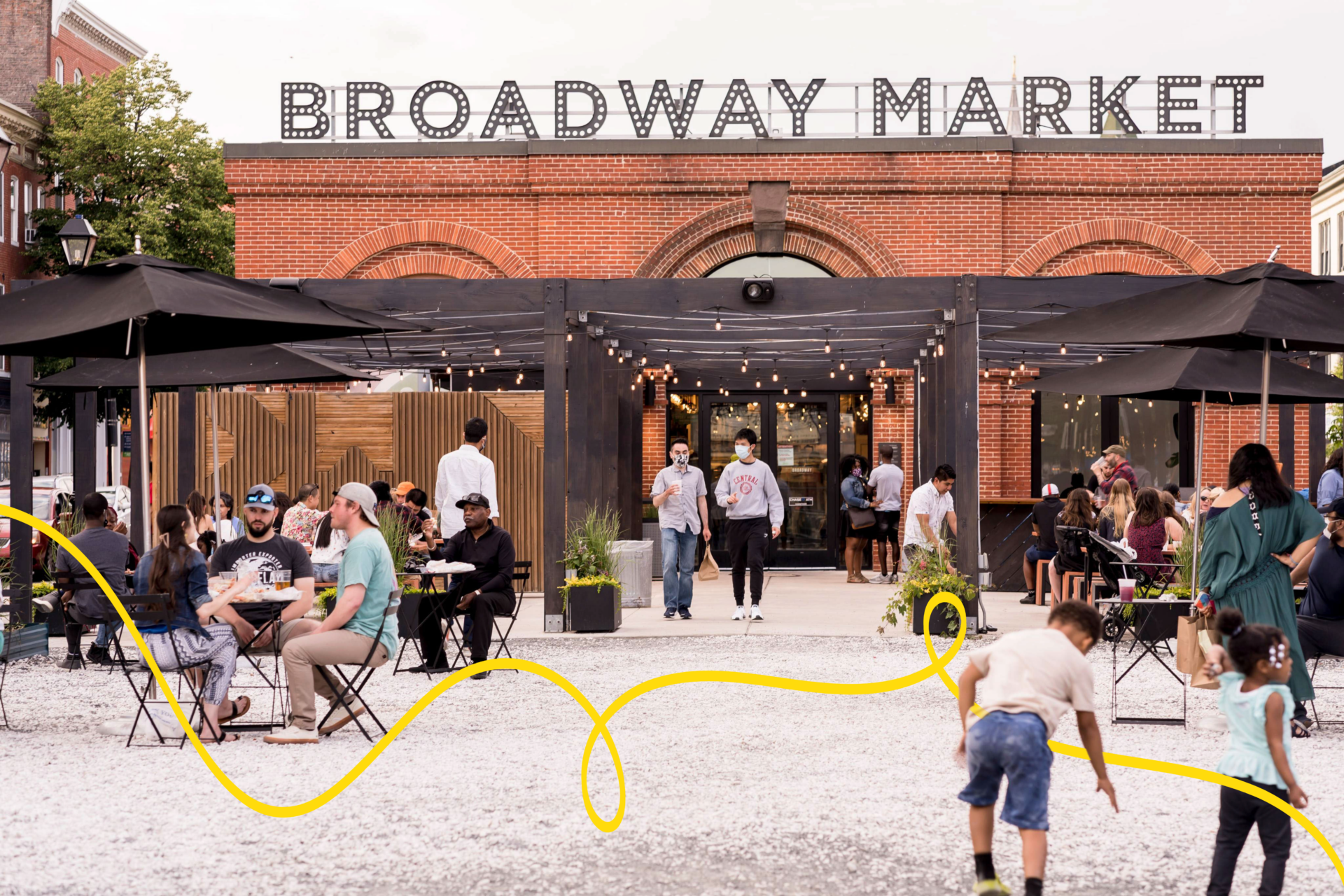
Baltimore’s Broadway Market, which was reopened in 2019 after nearly a decade of sitting empty. Source: Kittelson & Associates.
The Educated Guess
To be clear, Velo-city presentations were not advocating for throwing analysis out the window. Cities do not have to pick a corridor, plaza, or downtown street at random and hope people will show up. The cities that shared examples at Velo-city knew what signs to look for.
What I picked up from these sessions, and after thinking more about it in the time since the conference, is that the most promising opportunities are often places where the demand is already visible: high-value land uses, active storefronts, destinations close together, buildings that meet the street, and sidewalks or curb lanes that are already doing more than simply moving people past each other. In those places, we’re really just asking whether public space is being put to its highest and best use.
To draw on a recent event, take a look at where people gathered across your city to watch key games of the 2026 FIFA World Cup. In Boston, where I live, they shut down streets around Boston City Hall for watch parties. We also see it during festivals, markets, and parades, when a street that usually functions as a vehicle corridor suddenly becomes a space where people connect. If those spaces feel lively and intuitive when cars are temporarily removed, it’s worth asking if there are enough people, destinations, and street life to support a more permanent shift in that area.
Of course, signals exist outside special events, too. Where do people already linger? Where are sidewalks crowded? Where are businesses creating outdoor seating with barriers because people want to sit outside, but traffic makes the experience feel exposed? Where are people already walking between destinations, even if the street design does not yet support them well? When we can observe which spaces already have momentum (whether intentional or incidental), we can find opportunities to build on it.
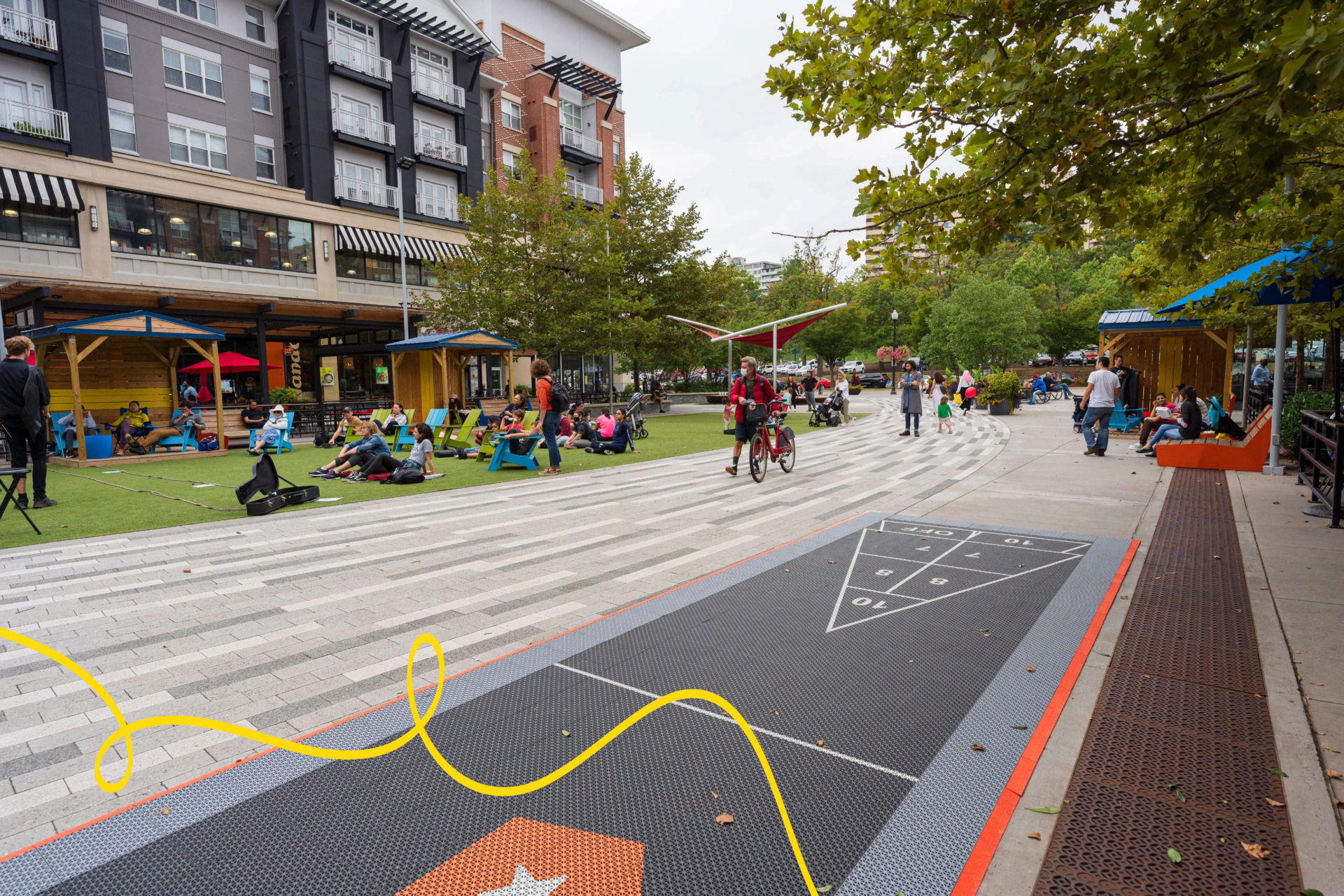
Pentagon Square in Arlington, VA. Source: Kittelson & Associates.
Bringing the Virtuous Cycle to Your City
In this industry, we sometimes talk about the vicious cycle of a reliance on driving fueling the demand for driving facilities that make driving the easiest and most comfortable way to get around. Velo-city reminded me there is a virtuous cycle, too. When walking and biking become safer, more comfortable, and more enjoyable, more people choose to walk and bike. As more people walk and bike, public spaces become livelier, storefronts benefit from more passersby, and the case for continued investment becomes easier to see. But it has to start with a choice.
I hope these ponderings encourage you like they have me. The world expanded for me at Velo-city 2026. Even though I’ve been studying examples from European cities for years, getting a peek behind the curtain at how their transportation professionals are working through questions and ideas in real time showed me just how similar our questions can be. Whether across county, state, or international borders, we have much to learn from the examples around us. We could dismiss a case study as too different, or we could ask what made it work and what that could look like in our context. And then we’re really getting somewhere.
Wherever you find yourself in this conversation, I’d welcome the chance to keep talking. The more honestly we engage with one another’s questions and experiences, the better equipped we’ll be to shape streets and public spaces that reflect the communities they serve. Reach out and let’s chat!